- Liquidität
Capital requirement plan – the foundation for secure financing and growth

A brilliant business idea or a planned growth project is only the beginning. To stop the venture failing halfway because the money runs out, precise planning is essential. This works best with a capital requirement plan. It determines exactly how much money is needed to finance the start-up, the investments and the initial phase safely. The following article explains which items belong in the plan, how to draw it up step by step and why it is often the deciding factor for banks and investors.
The key points in brief:
- Definition: the capital requirement plan determines the total financial need for a start-up, projects or expansions.
- Components: start-up costs, investments (fixed assets), initial operating costs (working capital) and a liquidity reserve.
- Purpose: it serves as the “price tag” of the venture and is the mandatory prerequisite for the financing plan.
- Objective: securing full funding through to the break-even point and convincing lenders and investors.
- Advantages: avoiding follow-up financing, a clear overview for investors, security in the start-up phase.
Table of contents:
- The capital requirement plan: definition and classification in business terms
- Structure and components: the four pillars of the capital requirement
- Creating a capital requirement plan: step-by-step instructions with a practical example
- Step 1: verify investments with quotations
- Step 2: determine start-up costs and fees
- Step 3: calculate the working capital requirement (initial phase)
- Step 4: add a reserve
- Capital requirement plan: example of a media agency (GmbH)
- The relevance of capital requirement planning for banks and investors
- Common mistakes in capital requirement planning and how to avoid them
- FAQs
The capital requirement plan: definition and classification in business terms
The capital requirement plan forms the financial foundation of every business plan. It answers the question of how funds are to be used and quantifies the total financial need that has to be covered before and while business operations get going. In business terms it stands at the beginning of financial planning. Only once the capital requirement (how much money is needed and what for?) has been established precisely can the financing plan (where does the money come from? equity vs. debt) be drawn up in the second step.
It is not enough simply to add up the amounts for investments in machinery or office furnishings. A professional capital requirement plan takes the time factor into account: it has to secure the company’s liquidity until the break-even point is reached. This means it also covers the operating gap in the initial phase, in which running costs (rent, staff, marketing) are already being incurred but revenues are not yet sufficient to cover them.
But what is a capital requirement? In practice it consists of two main areas:
- Long-term investment requirement: this includes all fixed assets that serve the company (e.g. property, vehicles, licences, IT hardware).
- Short-term working capital requirement: this covers current assets (inventory) as well as the pre-financing of running costs during the start-up phase.
If this precise distinction is missing, or if the initial phase is calculated too optimistically, there is a risk of needing follow-up financing. That is often difficult to push through with banks and signals a lack of planning competence to investors.
Structure and components: the four pillars of the capital requirement
For the capital requirement plan to fulfil its function as a reliable management tool, all expenditure must be recorded without gaps. In business practice, a division into four main categories has proved its worth. This structure not only helps with internal calculations, it is also decisive for external lenders and investors in understanding how funds are used (investment vs. consumption).
- Start-up costs and formalities: these are one-off expenses that are absolutely necessary in order to start business operations legally and organisationally. These costs often arise before the first euro of turnover is generated.
- Authorities and public offices: fees for business registration, entry in the commercial register and, where applicable, sector-specific permits or licences.
- Legal form costs: notary fees (especially for a GmbH or UG), costs for the articles of association and court fees.
- Advice: fees for tax advisers, lawyers or management consultants who help with drawing up the business plan or drafting contracts.
- Market entry: costs for market research, applications for intellectual property rights (patents/trademarks) and the corporate design (logo, website creation).
- Investments in fixed assets: this block covers all acquisitions of assets that serve the company in the long term. From the banks’ point of view this part often represents the “value-bearing” part of the financing, because these assets can (in part) serve as loan collateral.
- Intangible assets: purchase of software licences, patents, franchise fees or goodwill (in the case of a takeover).
- Tangible assets: property (purchase or conversion), machinery, technical equipment, vehicles, office and business equipment as well as IT hardware.
- Financial assets: holdings in other companies or long-term securities (usually less relevant for operational start-ups, but worth mentioning for the sake of completeness).
- Working capital and initial phase: this is the technically most demanding item in the capital requirement plan and the most common source of error. Here the pre-financing of ongoing business operations has to be calculated. The task is to bridge the period in which ongoing expenditure exceeds income (start-up losses).
- Initial inventory: procurement of the first stock of goods or materials in order to be able to deliver at all.
- Ongoing fixed costs: rent, staff, insurance, leasing instalments, energy and telecommunications for the first 3 to 6 months (or until the planned break-even).
- Marketing and sales: budget for launch campaigns, advertisements and sales activities to acquire customers.
- Pre-financing of receivables: if customers pay within a payment term (e.g. 30 days), this gap has to be covered in liquidity terms.
- Liquidity reserve and buffer: a static plan meets a dynamic reality. Unforeseen events, such as price increases for raw materials, delayed building permits or a sluggish start to operations, must not lead immediately to insolvency.
- Calculation: in practice a flat surcharge of 10 to 20 per cent on the total of the points listed above is often applied.
- Function: this reserve serves exclusively to cover risk and not to finance forgotten investments after the event.
Creating a capital requirement plan: step-by-step instructions with a practical example
Drawing up a solid capital requirement plan is not a guessing exercise but a process that has to be based on concrete quotations and realistic assumptions. Anyone who works with rough estimates here risks liquidity gaps later on. The process can be divided into four logical steps.
Step 1: verify investments with quotations
List all the acquisitions needed for fixed assets. Do not estimate the prices; obtain concrete quotations and cost estimates for larger items (machinery, vehicles, IT systems). This proves to banks that the requirement is real and in line with the market.
Step 2: determine start-up costs and fees
Research the exact costs for the notary, the commercial register and business registration. These vary depending on the legal form and the region. Also plan firmly for advisers’ fees in your capital requirement plan.
Step 3: calculate the working capital requirement (initial phase)
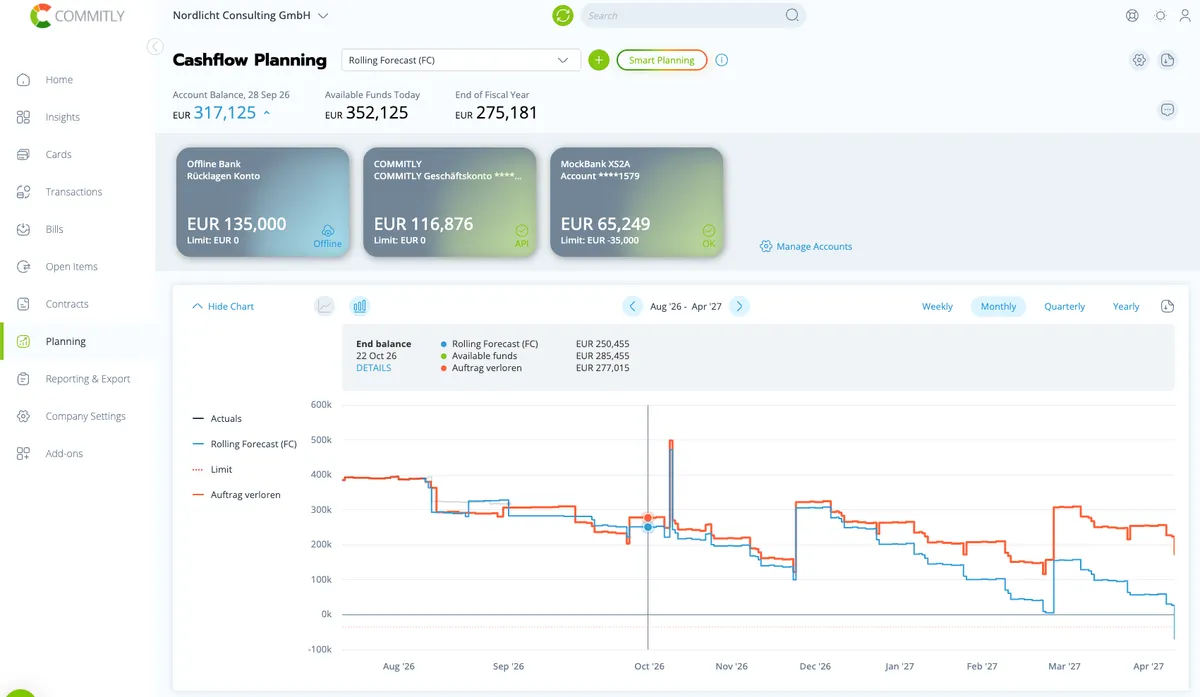
This is the most complex part. Draw up a forecast of the ongoing fixed costs (staff, rent, insurance) for the first 6 months. Deduct the conservatively estimated income from that. The difference is the capital requirement that has to be covered until cash flow turns positive. Once the business is up and running, a cash flow software takes this calculation off your hands every month.
Step 4: add a reserve
Add a safety buffer of approx. 10 to 15 per cent to the subtotal of all items.
Capital requirement plan: example of a media agency (GmbH)
The following fictitious example of an agency start-up illustrates how the total requirement is made up. It shows that the actual investments often account for only a part, while the pre-financing of ongoing operations (working capital) represents a considerable block.
Area | Item/purpose | Amount (EUR) |
|---|---|---|
Start-up costs | Notary, commercial register, local court Business registration, adviser's fee | EUR 1,200 EUR 2,500 |
Fixed assets | IT hardware & software Office equipment Deposit for office premises | EUR 12,000 EUR 8,500 EUR 4,500 |
Working capital | Marketing & website launch Pre-financing of staff & rent (for 4 months) Initial stock of materials | EUR 8,000 EUR 35,000 EUR 1,500 |
Subtotal | Total of items 1 – 3 | EUR 73,200 |
Reserve | Safety buffer (approx. 15% for the unforeseen) | EUR 10,980 |
Total capital requirement | Amount to be financed | EUR 84,180 |
The relevance of capital requirement planning for banks and investors
For external lenders and investors, the capital requirement plan is far more than a mere list of figures. It serves as an indicator of the professionalism of the management; banks and investors examine the plan primarily against two criteria:
- 1. Plausibility: are the assumed costs in line with the market? Have buffers been built in or has everything been cut to the bone? A capital requirement that is set too low is often viewed more critically than one that is somewhat too high, because follow-up financing is extremely unpopular and complicated in the banking process.
- 2. The ratio of investment to consumption: investors like to see a large part of the capital flowing into value-enhancing investments (product development, machinery, customer acquisition) rather than into excessive salaries or prestigious offices in the start-up phase.
Common mistakes in capital requirement planning and how to avoid them
Even experienced entrepreneurs make mistakes in capital requirement planning that can later lead to serious liquidity bottlenecks. The catch often lies in the detail or in assumptions that are too optimistic. Here are the most common stumbling blocks in the capital requirement plan and how to avoid them:
Mistake 1: the “net trap” (forgetting VAT) In business plans and profit and loss calculations, net amounts are used as a matter of principle. For liquidity, however, that is dangerous.
- The problem: when you make investments (e.g. a machine for EUR 50,000 net), you have to transfer EUR 59,500 (gross) to the supplier. You do get the EUR 9,500 input tax back from the tax office, but often only weeks or months later.
- The solution: plan this temporary pre-financing of VAT into the capital requirement as a short-term peak requirement.
Mistake 2: best-case planning for the initial phase In the capital requirement plan, many founders assume that revenues will start flowing immediately in the first month.
- The problem: delays in deliveries, technical installations or customer acquisition are the rule, not the exception. If turnover arrives two months later than planned, fixed costs such as rent and salaries still have to be paid.
- The solution: calculate in the “base case” (the realistic case) and also draw up a “worst case” scenario. Is liquidity still sufficient if turnover is 30% lower?
Mistake 3: the entrepreneur’s salary and private living costs This point mainly concerns sole traders and partnerships (GbR, OHG), not managing directors of a GmbH (whose salary is a business expense).
- The problem: in the start-up phase profit is often zero or negative. The entrepreneur, however, has to pay rent privately and eat. If they take money out of the company’s till, it is missing from the business.
- The solution: private living costs for at least 6 to 12 months must either be covered by the capital requirement (as a withdrawal) or secured by private reserves. They must not be ignored.
Mistake 4: a static view A capital requirement plan is often drawn up once for the bank and then filed away in a drawer.
- The problem: market prices change, projects shift. A rigid plan loses its validity after just a few weeks.
- The solution: the move to rolling liquidity planning, which stays up to date automatically with a liquidity planning software instead of ageing in a drawer.


Frequently asked questions
It is a detailed list of all the financial resources needed for starting a business, an expansion or a project. It answers the question: "How much money do I need in total until the venture supports itself?"

From reading to doing
The capital requirement plan answers the starting question. After that, what counts is whether the plan holds — COMMITLY shows you that month after month.