- Liquidität
The difference between cash flow and liquidity

The two terms are often used interchangeably, but for finance managers, controllers and CFOs the difference between cash flow and liquidity matters. Both metrics describe a company’s financial stability, but from different perspectives. While one secures its current ability to survive (solvency), the other indicates the sustainable earning power and internal financing strength of the business model. The following article analyses the correct commercial distinction and shows how both metrics work in practice.
The key points in brief:
- What is liquidity? The term describes the financial resources available on a given date, the actual position, for settling liabilities as they fall due without restriction.
- What is cash flow? This describes the balance (the flow) of incoming and outgoing payments over a defined period. It measures the change in the cash position.
- The connection: a positive cash flow tops liquidity up. If it is negative (cash burn), it eats liquidity away.
- Why the distinction (cash flow vs. liquidity) matters: a company can be liquid (a full account thanks to a loan) but burn money operationally (negative cash flow). Both have to be monitored separately.
Contents:
- Why the distinction between cash flow and liquidity is so important
- Status vs. movement: why the difference between cash flow and liquidity determines the economic position
- Not all liquidity is healthy: the three types of cash flow
- Leverage in practice: managing vs. optimising
- The life cycle factor: how the relationship between the metrics changes
- Cash flow vs. liquidity – differences in the calculation
- FAQs
Why the distinction between cash flow and liquidity is so important
To assess a company’s financial robustness reliably, a one-dimensional view is not enough. In commercial analysis a strict distinction has to be made between two dimensions: the stock figure and the flow figure. This difference (cash flow and liquidity) is not academic hair-splitting but the foundation of any correct cash flow planning and risk analysis. Anyone who mixes these two levels up risks misinterpreting the actual economic position.
Liquidity is the snapshot (the photograph)
A company’s liquidity describes a state at an exact point in time, usually the current day or the balance sheet date. It is a static stock figure. It answers the question: “Are we solvent? Yes or no?” It is made up (in the narrower sense of first-degree liquidity) of cash in hand and the available bank balances. If you widen the view to include what can be drawn on, unused credit lines count as well. This stock figure therefore describes the result of all past decisions up to the present second. It is the safety net that stops a company sliding into insolvency.
Cash flow is the film (the plot)
Cash flow, by contrast, is a dynamic flow figure. It never looks at a single moment but always at a period (January, Q1 or the financial year, for example). It answers the question: “How has our cash position changed, and why?” Cash flow measures the actual payment flows, that is, the money that physically comes in (cash in) and goes out (cash out). It strips out all accounting distortions such as depreciation or provisions. A positive cash flow means that the company generated a surplus of liquid funds in that period (internal financing strength).
Status vs. movement: why the difference between cash flow and liquidity determines the economic position
Without distinguishing between the status (we have money in the account) and the movement (where does the money come from?), the true cause of changes in liquidity remains in the dark. This is exactly where many companies come unstuck, especially at the start: they rest on a high level of liquidity without noticing that their operating business is no longer running as it should and that financial stability is missing.
To manage this risk, finance managers have to understand that liquidity is blind to its own origins. A euro in the bank account always looks the same, whether it comes from a profitable customer order, from selling operationally essential fixed assets or from a freshly drawn loan. The difference between cash flow and liquidity here lies in what they tell you about future viability:
- Liquidity signals nothing more than current ability to act. If it is high, that can nevertheless be deceptive. It may, for example, have been artificially inflated by releasing hidden reserves or by a massive increase in borrowing. Anyone who looks only at this metric treats the symptom but ignores the diagnosis.
- The payment flow reveals how the liquidity came about. If it is negative while liquidity is high, that is a classic warning sign of substance being consumed. The company is not living off its performance but off its reserves or its debt. Conversely, a company with (as yet) low solvency can be perfectly healthy if the operating cash flow is positive and growth is merely tying up capital temporarily (building working capital).
Not all liquidity is healthy: the three types of cash flow
To understand the difference between cash flow and liquidity you have to look deeper than the total at the end of the month. For assessing a company’s creditworthiness (by banks under Basel III, for example) the source of the liquid funds is decisive. The cash flow statement divides cash flow into three types that have different effects on solvency:
- Operating cash flow: this is the most important indicator of resilience against insolvency. It shows whether the core business (revenue minus operating payments) generates liquidity by itself. A permanently negative operating cash flow cannot be cured by financing measures.
- Cash flow from investing: this is often negative in growth phases (money flowing out for machinery, software). That is strategically intended. A positive investing cash flow, by contrast, can be a warning sign (“selling the family silver”) if payment capacity is only being generated by selling fixed assets to plug holes.
- Cash flow from financing: this shows inflows from loans or equity. It does increase solvency (status) in the short term, but interest and repayments weigh on future cash flow (movement).
Position and movement in one picture.
COMMITLY reads your account balances live and projects your cash flow from them — you see both side by side.
Leverage in practice: managing vs. optimising
In financial management, liquidity problems call for different measures than cash flow problems. Anyone who knows the difference between cash flow and liquidity applies the right tool to the right problem. Both levels together are shown by ongoing liquidity planning: today’s position and the movement of the coming weeks.
Levers for a company’s short-term liquidity (treating the symptom): if insolvency threatens, measures are needed that increase the stock immediately, often irrespective of earning power.
- Factoring: selling receivables for immediate cash in.
- Sale and lease back: selling fixed assets while leasing them back.
- Stretching liabilities: making use of suppliers’ payment terms (careful: mind the supplier relationship).
- Drawing on credit lines: using overdraft facilities.
- Effect: immediate solvency, but often at the cost of the margin (factoring fees, interest).
Levers for sustainable cash flow (tackling the cause): to secure financial health in the long term, the flow figure has to be optimised. This is where operational improvements come in.
- Pricing power & margin improvement: increasing the gross profit per unit sold.
- Cost management: reducing the fixed cost base (staff, rent, licences).
- Working capital management: optimising stock turnover and shortening DSO (days sales outstanding) through better credit control. Anyone who keeps their open items permanently in view spots late-paying customers sooner.
- Effect: these measures work more slowly, but they ensure the company stays liquid under its own steam.
The life cycle factor: how the relationship between the metrics changes
A static view falls short, because the significance of the two metrics shifts depending on the company’s phase. Seen in the context of the corporate life cycle, typical patterns can be recognised more easily and risks anticipated when analysing the differences between cash flow and liquidity.
Phase 1: start-up & seed (high liquidity/negative cash flow)
Young companies often start with bank accounts full to bursting thanks to funding rounds (high liquidity). At the same time the business model is not yet viable and the “burn rate” is high (heavily negative operating cash flow).
- The risk: the high liquidity lulls founders into a false sense of security and financial stability. The focus here has to be squarely on the runway – that is, the period until solvency has been used up by the negative cash flow.
Phase 2: growth & scaling (low liquidity / positive profit)
Revenue explodes and the company is in the black. Yet solvency often falls dramatically. Why? Because growth has to be pre-financed (building stock, receivables from customers).
- The risk: the growth trap. The company is profitable but illiquid. This is where the difference between cash flow and liquidity becomes painfully clear: the profit is in the books, but the cash is tied up in working capital.
Phase 3: maturity & cash cow (high liquidity / positive cash flow)
Established companies have optimised processes and stable revenues. The need to invest falls.
- The scenario: operating cash flow is higher than what is needed and payment capacity builds up (excess cash). The strategic question is now: distribute it (dividends) or reinvest it?

Cash flow vs. liquidity – differences in the calculation
Looking at how they are calculated also makes the difference between cash flow and liquidity immediately clear. The two metrics are made up of completely different building blocks. In practice this often causes confusion when the tax advisor says, “You have a profit and a positive cash flow”, yet the bank account is empty all the same.
- Calculating liquidity – what can I spend? If you want to know how liquid you are today, it is not just the money in the account that counts. It includes everything you can access immediately.
- The simple formula: balances in bank accounts + cash in hand + unused credit lines (overdraft/current account) = available liquidity
- The decisive point: the mistake often made here is to forget the credit line. A company with EUR 0 in the account but an open credit line of EUR 100,000 is liquid. It can pay. Solvency therefore measures the potential.
- Calculating cash flow – what has been earned? Cash flow is not interested in your credit line. It wants to know what money your business operations have generated. In practice (the indirect method) you start from the profit and adjust it.
- The simple formula: net income for the year (profit) + depreciation (costs on paper, but no money flowing out) +/- changes in inventories and receivables = operating cash flow
- The decisive point: this is often where the misunderstandings come from. Depreciation reduces your profit (good for tax) but costs you no liquidity (good for cash flow). That is why the payment flow is often higher than the profit reported.


Both updated daily from bank and accounting — with a forecast.
Try it for free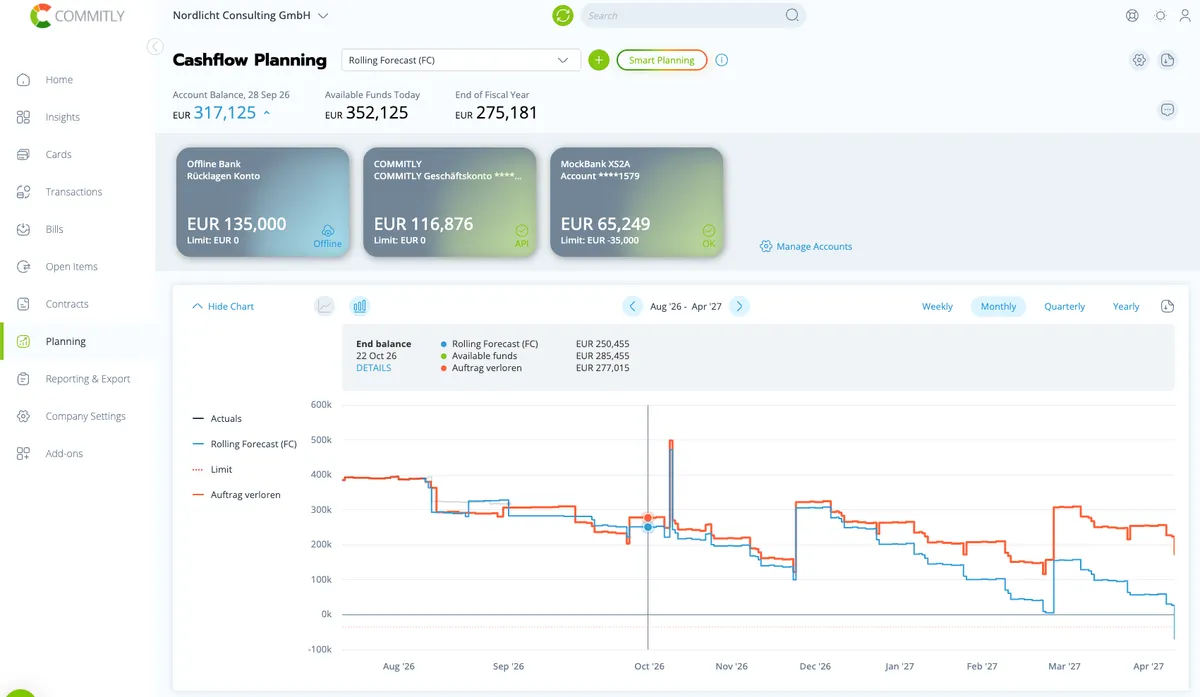
Frequently asked questions
Above all it is the time dimension that distinguishes the two metrics: liquidity is a static stock figure at a given date (how full is the tank today?). Cash flow is a dynamic flow figure over a period (how much is flowing in or out?).

From reading to doing
You now know the difference — COMMITLY shows you both for your company: the position today and the flow of the coming weeks.