- Business
What determines the price when selling a property? A look behind the façade

Selling a property is always a big decision. But what exactly determines the price a seller can ultimately ask for – and possibly achieve? The property market is a complex interplay of economic conditions, personal factors and strategic considerations. In this article we take a look at the central influencing factors and also examine the perspective of potential buyers – including the so-called “bargain hunters”.
1. The market situation: economy, interest rates & demand
Before a price tag even comes into play, the wider market sets the framework:
Economic growth & the labour market
A growing economy and a stable labour market strengthen buyer confidence. More people can afford a property – demand rises, and with it prices. In economically uncertain times, by contrast, the willingness to make large investments declines.
Interest rate levels & financing costs
The level of interest rates has a direct influence on purchasing power. In low-interest phases buyers can finance more without overstretching themselves – which drives prices up. Rising interest rates, on the other hand, push down the affordable loan amount, which can act as a brake on prices.
Supply & demand
A tight supply combined with high demand (e.g. in conurbations) leads to rising prices. Conversely, an oversupply – for example through new-build projects or people moving away – can dampen prices.
2. Price formation: how is a property’s value calculated?
Valuation methods
Property valuation is not an exact science, but there are clear guidelines:
a) Asset value method
Here the price is determined on the basis of the building’s construction costs plus the land value. Particularly relevant for detached houses.
b) Income capitalisation method
For rented properties, what counts is how much return they generate. Rent levels, vacancy risk and management costs are all factored in here.
c) Comparative value method
This method compares similar properties in the area that have already been sold. It is the most common approach for flats and detached houses.
d) The market decides
Despite all the models: the actual purchase price always results from the interplay of supply and demand. In the end a property is worth what a buyer is prepared to pay.
Practical price setting in everyday sales
In practice, a mix of market observation, comparative analyses and tools is always used.
1. Comparative value through market analysis
The most common method in practice – especially for flats and detached houses:
- How much have comparable properties in the area cost recently?
- Data sources: property portals, valuation committees, estate agent databases (e.g. Sprengnetter, ImmoWert)
- Criteria: location, living space, condition, year of construction, plot size, fittings
- Estate agents use market reports & experience here.
Practical tip: sellers often look first at platforms such as ImmoScout24 or Immowelt, but those show asking prices – not the sale prices actually achieved. That can lead to overestimates.
2. Online valuation tools
Many portals offer free or paid online calculators. Based on inputs such as location, size, year of construction & fittings, they produce an estimated value.
- Advantage: quick, low-threshold, a good first point of reference
- Disadvantage: no allowance for particularities such as condition, neighbourhood, micro-location
Examples: ImmoScout valuation, Homeday, Sparkassen-ImmoWert, McMakler calculator
3. Estate agent assessments
Professional estate agents often offer a free market value analysis – usually in order to win a sales mandate.
- A combination of experience, comparable properties & their own market assessment
- Realistic, but sometimes slightly optimistic in order to secure the sales mandate
- Many estate agents use software tools (e.g. from Sprengnetter, FlowFact, onOffice)
Reputable agents provide transparent reasoning and do not propose fantasy prices.
4. Emotional price setting by owners
Many private sellers set a price themselves – often shaped by emotion:
- Investments (“But I put EUR 300,000 into a new heating system…”)
- Desired profit (“I need at least EUR 400,000 profit for a new investment…”)
- Neighbourhood / comparison (“The property next door sold for EUR 2,500,000, but my location is better …”)
Not infrequently this leads to excessive asking prices – with the risk of a long selling period or price negotiations.
3. The role of seller and buyer
The seller
Not everyone sells voluntarily. Inheritances, divorces, relocations or financial bottlenecks influence motivation – and often the willingness to negotiate as well. An emotional value can feed into the price expectation, which is not always in line with the market. In such cases in particular: beware of bargain hunters!
The buyer
There are different situations on the buyer’s side too: owner-occupiers want to find “their home”, while investors judge soberly by return. Budget, financing scope and urgency influence behaviour – a couple whose tenancy is about to expire acts differently from an investor with a broad portfolio.
4. The bargain hunters: motivations and strategies
A particular “player” on the property market are the bargain hunters – usually experienced buyers who deliberately look for undervalued properties or ones in need of refurbishment.
Typical characteristics:
- A good understanding of the market: they know prices, locations and potential precisely.
- A calculated eye for refurbishment: what looks like a “ruin” to a layperson is an investment with a margin for them.
- Negotiating skill: they often speculate on the seller’s weakness – time pressure, divorce, insolvency.
- Fast decisions: with equity or secured financing they can strike quickly.
For sellers this can be tempting – especially when the pressure to sell is high. But a supposed bargain often means a “sale below value” for the seller.
5. Investor logic: rental yield, rents, vacancy & factor
With investment properties it is not emotions that count, but figures. Investors assess properties like a business model. The following factors play a central role:
Rental yield (gross yield)
The rental yield is a percentage comparison of rental income to the purchase price – a key figure for investors.
Formula:
Rental yield (%) = (annual net cold rent / purchase price) × 100
This key figure shows at a glance how profitable a property is in relation to the purchase price. The higher the yield, the more attractive – at least on paper.
Note: investors always view the rental yield in comparison with alternative investments. Property is generally regarded as a fairly low-risk investment, so the alternatives are investing the investor’s money in government bonds, for example.
Actual rent vs. target rent
- Actual rent: the rental income currently being achieved.
- Target rent: the amount that would be possible according to market potential or the local rent index.
A large difference between actual and target rent can indicate development potential (but also risk). A property with a very low actual rent but high target potential offers development opportunities – for example through a change of tenant, refurbishment or indexation.
Example:
- Annual rent: EUR 180,000
- Purchase price: EUR 3,000,000 → rental yield = 6.0%
Note: this is the gross yield – excluding incidental purchase costs, maintenance, management and so on. The net yield is often considerably lower.
Vacancy
Vacancy reduces income – temporarily it is manageable, permanently it is a risk factor. Reasons can be a poor location, poor condition or rents that are too high.
Vacancy means missing income – correspondingly negative for income and value.
- Temporary vacancy: interim letting, modernisation – often possible to factor in
- Structural vacancy: due to poor location, condition or rent level – critical!
Investors assess vacancy in terms of risk: the higher the vacancy, the higher the risk discount.
The factor (multiplier): how investors think
The factor (also called the multiplier) is a central figure in price formation in the investment sector.
Formula:
Factor = purchase price / annual net cold rent
Example:
- Purchase price: EUR 5,000,000
- Annual rental income: EUR 250,000 → factor = 20
A high factor usually means a lower rental yield. Investors use the factor for a quick assessment:
- Factor 15–18: attractive in good locations
- Factor 20+: only acceptable in top locations or with very low risk
What do these values mean in practice?
- High actual rent + low factor: a very attractive property, but often expensive (little development potential)
- Low actual rent + high target rent: an increase in value is possible, but with risk (modernisation, change of tenant, permits)
- Vacancy + favourable factor: an opportunity for investors – but beware of permanent problems (location, fabric)
- High factor + little development potential: overpriced from an investor’s point of view
Conclusion: for investors it is a game between cash flow and potential
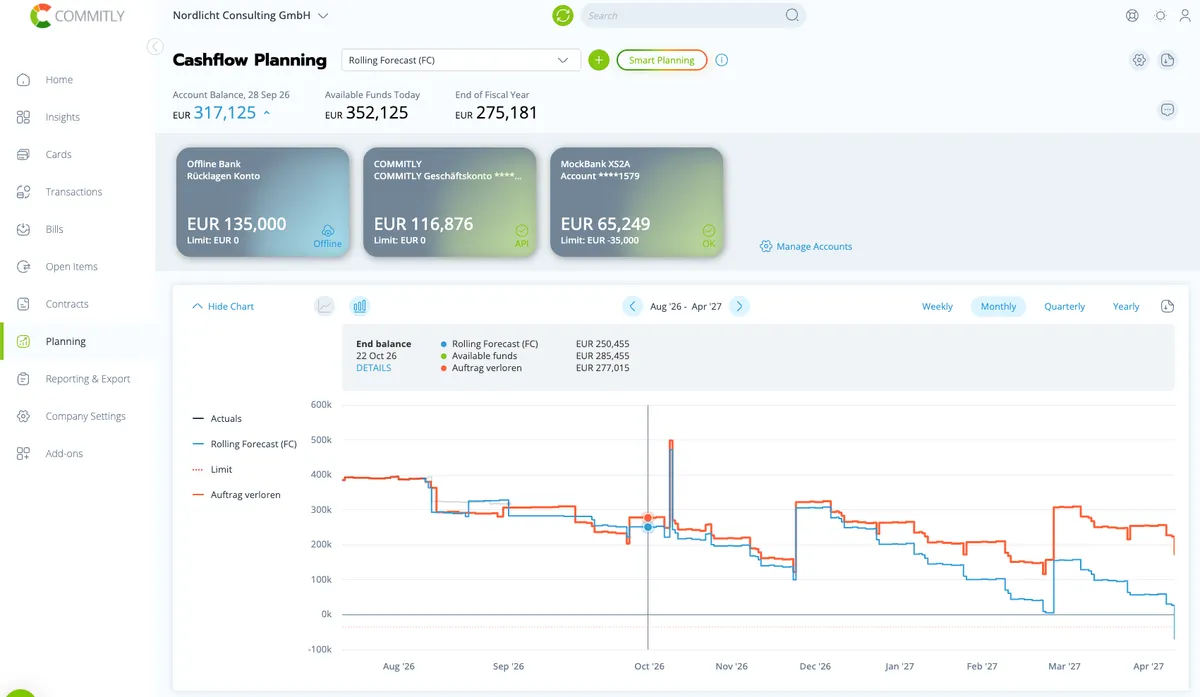
These key figures help to assess the economic value of a property realistically – beyond location and emotions. Anyone holding several properties is best doing this calculation in ongoing liquidity planning rather than in one spreadsheet per property. Buyers who do the maths look at:
- How much cash flow does the property generate?
- How stable is that cash flow?
- Is there potential to increase it (rent, occupancy)?
- Is the price being asked fair in relation to these figures?
- Is there possibly an alternative use for the property that only the investor knows about?
Sellers, in turn, should know:
The better the figures and prospects, the higher the price that can be achieved – even with bargain hunters.
6. Options & alternatives: how flexible are buyers and sellers?
Options for sellers
- Waiting for the right moment: if there is no time pressure, it can be worth waiting for market trends.
- Letting instead of selling: anyone who needs income can also let the property and keep it as an investment.
- Partial sale or life annuity (in the private sphere): for older owners in particular there are new models that release liquidity without selling completely straight away.
Options for buyers
- Alternative locations: those who are flexible often find better terms in the surrounding area or in less sought-after locations.
- Existing properties instead of new builds: properties suitable for refurbishment can be cheaper and bring tax advantages.
- Patience & market observation: in volatile times in particular it pays to watch price movements and not strike immediately.
Note: always know the other party’s options. If the buyer can easily acquire similar properties in that location, for example, a high price will be rather unlikely. If the buyer needs the property or plot to expand their own site, the buyer will be more willing to pay a higher price.
Conclusion: property prices are more than square metres and location
The price of a property arises in the field of tension between the economic situation, valuation mechanics and human motives. Sellers should calculate realistically – and not be guided solely by emotional value. Buyers, in turn, benefit from a clear strategy and market knowledge. And bargains? They do exist – but rarely without a catch.
Those who act cleverly stay flexible and informed – because in the end the market decides, but both sides can play along.



From reading to doing
Whether a property carries itself is decided by the payment flow. COMMITLY plans it — per property, per company or across the whole portfolio.