- Liquidität
Defining liquidity: cash, net cash fund or net working capital?

Liquidity management is the lifeblood of every company. But “liquidity” is not always the same as “liquidity” — depending on how you define it, you take different decisions, run different risks and have to deal with different levels of complexity in working it out.
In this article you will learn:
- Which levels of definition of liquidity exist,
- How the risk profiles differ,
- How these definitions relate to the classic liquidity ratios of the 1st, 2nd and 3rd degree,
- What complexity you face in working them out,
- And which practical recommendations follow from all this.
The three levels of defining liquidity
1. Cash (narrow definition)
Definition: only the actual account balances in bank accounts + cash on hand.
Example: bank balances, cash on hand.
Important: no receivables or other current assets are included.
2. Net cash fund
Definition: liquid funds plus very short-term receivables minus short-term liabilities.
Typical components:
Liquid funds
+ short-term receivables (e.g. customer receivables falling due very soon)
– short-term liabilities (e.g. open supplier invoices)
Purpose: to show what funds are available once amounts flowing in and out very soon are taken into account.
Formula:
Net cash fund = liquid funds + short-term receivables – short-term liabilities
3. Net working capital
Here the thinking is broader still:
Liquid funds
+ current assets (receivables, inventories, etc.)
– short-term liabilities (suppliers, short-term loans, etc.)
In effect: you include the entire working capital (current assets minus current liabilities).
Formula:
Net working capital ≈ liquid funds + short-term receivables – short-term liabilities + inventories (defined as very short-term)
Summary:
Term | Scope | Note |
Cash | Bank + cash on hand only | extremely liquid |
Net cash fund | Cash + receivables – liabilities | available at short notice |
Net working capital | Net cash fund + further current assets (e.g. inventories) | broader still, more a liquidity perspective on working capital |
Why these distinctions matter
- Reporting: depending on the recipient and the purpose (e.g. investors, banks), different definitions of liquidity are required.
- Crisis scenarios: in stressful situations what usually matters is the “real” available cash – and therefore the narrow definition.
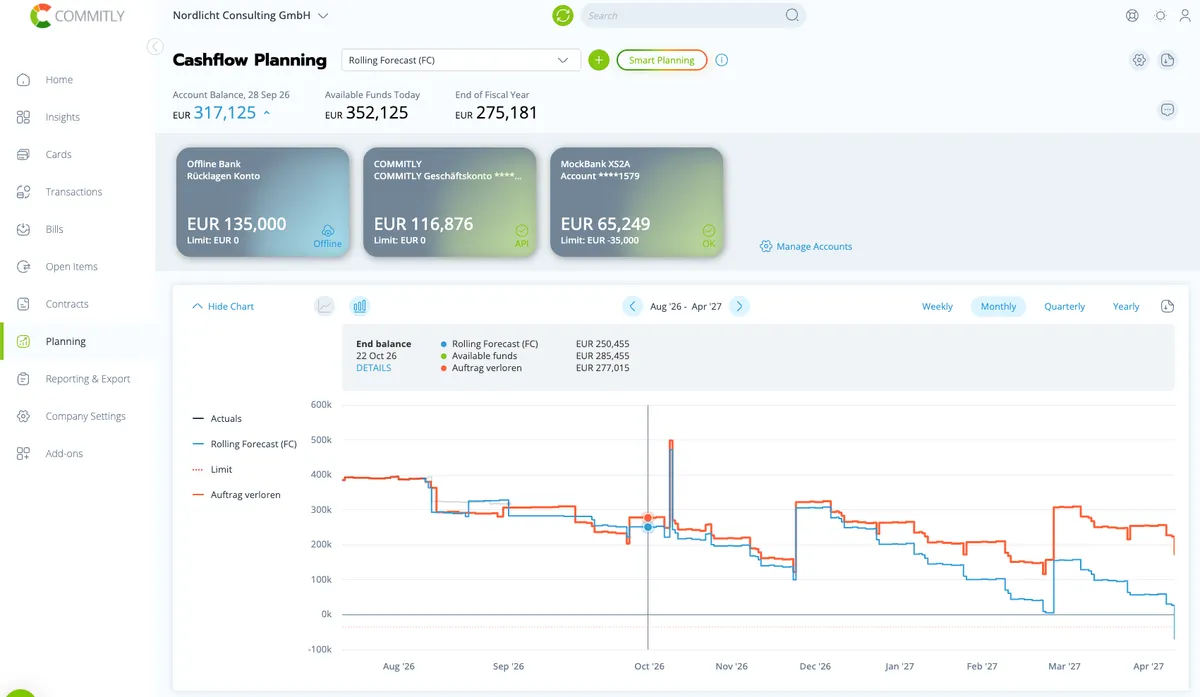
- Planning: for rolling cash flow planning (e.g. with COMMITLY) it makes sense to include receivables and liabilities (= open items).
The risk profiles of the definitions
These different definitions of cash have different risk profiles, because they relate to how reliably you can access those funds.
Here is a structured overview of the risk classification:
1. Cash (account balances and cash on hand only)
- Risk: very low
- Reason: immediately available. No uncertainty. No default risk.
- Typical risk:
- Bank risk (e.g. insolvency of a bank → usually limited by deposit protection)
- Currency risk (in the case of foreign currency accounts)
2. Net cash fund (cash + receivables – liabilities)
- Risk: medium
- Reason: receivables might not be paid, or be paid later; liabilities can fall due earlier than planned.
- Typical risks:
- Bad debt risk: customers pay late or not at all.
- Receivables quality risk: receivables may exist but be hard to collect (e.g. in a crisis).
- Liabilities: suppliers or banks demand short-term payments sooner (liquidity bottleneck).
- On top of that: receivables ≠ cash → “near cash” with uncertainties.
3. Net working capital (cash + receivables – liabilities + inventories)
- Risk: high
- Reason: it contains items such as inventories, which in an emergency cannot be liquidated immediately, or only at a discount.
- Typical risks:
- Inventory valuation: stock loses value (obsolescence, spoilage, collapsing market prices).
- Liquidation risk: inventories may have to be sold below value.
- Timing risk: selling takes time, but the need for liquidity is immediate.
Summarised as a risk scale
Definition | Availability risk | Typical risks |
Cash | Very low | Bank risk, currency risk |
Net cash fund | Medium | Bad debts, liabilities falling due early |
Net working capital | High | Stock write-downs, delays in liquidation |
The broader the definition, the greater the uncertainty about whether the funds really are quickly available.
Practical tip
- For liquidity management: always focus on cash and the net cash fund first.
- For company valuation or crisis scenarios: better not to present net working capital as available at short notice, because there are considerable uncertainties.
How this relates to the liquidity ratios of the 1st, 2nd and 3rd degree
The liquidity ratios of the various degrees are classic key figures for the liquidity analysis of a company, particularly in balance sheet analysis.
Here are the definitions:
Liquidity ratio | Formula | Meaning | Target value |
Liquidity ratio, 1st degree (cash ratio) | Liquid funds ÷ short-term liabilities × 100 | Can the company settle its short-term debts with cash/bank balances alone? | 20–30% |
Liquidity ratio, 2nd degree (quick ratio) | (Liquid funds + short-term receivables) ÷ short-term liabilities × 100 | Can short-term liabilities be covered with liquid funds and receivables falling due soon? | 100% |
Liquidity ratio, 3rd degree (current ratio) | (Liquid funds + short-term receivables + inventories) ÷ short-term liabilities × 100 | Can short-term liabilities be covered with the entire current assets? | 120–200% |
Comparison with the “cash fund” definitions:
Term | German equivalent | Differences |
Cash (account balances only) | Liquidity ratio, 1st degree | Almost identical |
Net cash fund (cash + receivables – liabilities) | Similar to the liquidity ratio, 2nd degree | But a net view (balance), not just a ratio |
Net working capital (incl. inventories) | Liquidity ratio, 3rd degree | Similar scope, but you often look at absolute funds instead of only the relation to debts |
The decisive difference:
- Liquidity ratios 1–3 are ratios (quotas, percentages); they measure “coverage levels” in relation to short-term debts.
- The funds (cash fund / net cash fund) are more like absolute amounts: how much liquid substance do you effectively have available?
In short:
- Liquidity ratios 1/2/3 = ratios (in %)
- Cash fund / net cash fund = amounts (EUR)
Note: the classic liquidity ratios measure ratios (percentages), whereas the fund definitions look at absolute amounts.
Complexity of working them out
The further you move away from cash, the more complex and uncertain the calculation becomes. Here is a structured comparison that addresses exactly this point:
Comparison: complexity of the calculation
Criterion | Cash | Net cash fund | Net working capital |
Calculation | Very simple: bank and cash balances directly from account statements / bookkeeping | Medium: liquid funds + receivables – liabilities → requires an analysis of open items (debtors, creditors) | High: valuation of inventories/other current assets is needed as well |
Data sources | Bank postings, cash book | Accounts receivable, accounts payable, payment term analyses | Debtors/creditors + stock valuation, stocktakes or inventory discounts where applicable |
Update frequency needed | High (daily/several times a week is sensible) | Medium (weekly/monthly) | Low to medium (monthly or quarterly is usual) |
Scope for judgement | No scope (balances are fixed) | Scope in assessing when receivables/liabilities fall due | Considerable scope in valuing inventories (e.g. write-downs, market prices) |
Risk of errors | Low | Medium (receivables can be valued incorrectly or overlooked) | High (inventories may be assumed too optimistically) |
Effort of the calculation | Low | Medium | High |
IT/system requirements | Low (bank connection, account statements) | Medium (open items, maturity analyses, ERP interfaces) | High (inventory management, accounting requirements, manual reworking where applicable) |
The more components are included, the more laborious and uncertain the liquidity calculation becomes.
Summary of the levels of defining liquidity
Definition of liquidity = cash:
- Simple
- Very reliable
- Low susceptibility to error
Definition of liquidity = net cash fund (receivables and liabilities in addition):
- Requires accounting data and maturity analyses
- Risk from payment defaults or liabilities being called in earlier
Definition of liquidity = net working capital (inventories in addition):
- Complex (valuation of inventories)
- Considerably higher uncertainty about actual availability
- High effort and scope for interpretation
Recommendations and tips
- Operational cash management: work with the narrowest definition (cash) for day-to-day business.
- Forecasting: use the net cash fund for short- to medium-term planning (including receivables and liabilities).
- Strategic analyses: use net working capital only for longer-term or balance sheet valuations, but not for short-term liquidity decisions.
- Ensure data quality: with the net cash fund and net working capital, up-to-date and correct accounting data is essential.
- Create transparency: communicate clearly which definition you are using — internally and externally. Otherwise differing expectations can lead to serious misunderstandings.
Choosing the right definition of liquidity is not a purely technical matter — it determines the reliability, speed and accuracy of your financial decisions. Anyone who misjudges the risk and the complexity runs the danger of overlooking liquidity bottlenecks or getting lost in laborious, error-prone calculations.
A final tip: always start with “cash” and only widen your view when the information you gain justifies the added complexity.