- Liquidität
Open items – meaning, an overview of all outstanding items & why they matter for liquidity

When it comes to a transparent view of all receivables and payables as well as the active management of a company’s liquidity, open items play a central role. They make sure that outstanding invoices remain traceable at all times and that no payment slips out of sight. The following article explains the meaning of open items, their definition, how they work and why they are indispensable for a company’s financial stability.
The most important points in brief:
- Definition: open items – an overview of all receivables still outstanding (accounts receivable) and payables still outstanding (accounts payable).
- Function: a transparent overview of payments, due dates and dunning status.
- Meaning: open items show at an early stage when money comes in or goes out and where bottlenecks are looming, which makes them important for liquidity and planning.
- Benefits: prioritisation of overdue items, clarity, improved financial planning, use of early payment discounts, structured dunning, fewer defaults, predictable cash flow
Table of contents:
- The meaning of open items – definition & explanation
- What is an open items list?
- Open items accounting: example with a table
- Open items as a decisive lever for your company and its liquidity
- Tips for implementing open items correctly: how to run your list efficiently
- The meaning of open items in practice: common mistakes, their consequences and how to avoid them
- Open items meet planning: how your liquidity becomes predictable
- FAQs
The meaning of open items – definition & explanation
Many entrepreneurs know the feeling: a glance at online banking shows that there is less money in the account than expected. Accounting quickly reveals the reason: some customers have not yet paid their outstanding invoices.
- Open items – invoices from suppliers or customers that have not yet been settled.
In accounting, open items are defined as all invoices that have not yet been paid in full. This can be the case on the expenditure side, when a company still has outstanding payables towards suppliers, as well as on the income side, when customer invoices are still pending. At its core, then, it covers all incoming and outgoing invoices for which the payment process has not yet been completed. You can think of them as a kind of “stopover” in the flow of funds: the money is either already on its way to the recipient or is still expected, but has not yet definitively arrived. Open items therefore act as the interface between classic, backward-looking bookkeeping and forward-looking liquidity planning.
In practice, open items mean that cash flows become traceable and manageable. That is why they matter for small and large companies alike when it comes to securing liquidity.
What is an open items list?
This is an overview in which all items and invoices still outstanding are listed in detail. It helps to ensure that no outstanding receivable is overlooked and that reminders and payment terms are managed precisely.
Important for the meaning of open items: the open items list differs fundamentally from general accounting, because accounting presents all of a company’s figures. Or, to put it more precisely: within accounting, it is a separate statement of entries that have not yet been cleared, and it is kept in more detail than a plain totals and balances overview.
By the way: the difference between accounts receivable open items and accounts payable open items
Debtor open items = on one side there are the items on creditor or supplier accounts. They show unpaid invoices from suppliers or service providers. As soon as the payment is made and posted, the item disappears from the list automatically. How long it stays there depends on the agreed payment terms. That can be a few days, but sometimes months, for example in the case of retentions in construction or project contracts.
Creditor open items = on the other side there are the items on debtor or customer accounts. This is where invoices issued to customers that have not yet been paid are recorded. As soon as the money comes in and the payment is posted in accounting, this item is marked as settled as well.
Open items accounting: example with a table
The following example makes the meaning of open items easier to grasp. It explains all the important fields and terms. A table then illustrates the whole picture.
Open items list: an explanation of all fields and terms
- Invoice/document number: for clear matching and traceability
- Customer data: company/customer name, address, contact person if applicable
- Invoice date: decisive for the deadlines
- Outstanding amount: (net/gross) for the effect on liquidity
- Payment term: due date for managing the timing of reminders
- Status: (open/partly paid/settled)
- Ageing/days overdue: risk assessment & prioritisation
- Dunning level: to keep track of the reminders sent so far
- Further information and notes: for transparency within the team
Example table:
The following example shows how to read and understand the individual fields of an open items list correctly. This also makes clear the meaning of open items and, above all, why they matter in practice.
Invoice | Customer | Invoice date | Outstanding amount | Payment term | Status | Days overdue | Dunning level | Further information |
RE-2025-0148 | Beispiel GmbH, Str. 24, 80331 Munich, contact: Ms Muster | 02/09/2025 | EUR 3,500 | 02/10/2025 | open | 18 | 1 | Reminder sent in writing, payment promised by 02/10 |
RE-2025-0332 | Bürobedarf Beispiel KG, Str. 7, 70563 Stuttgart, contact: Mr Muster | 28/09/2025 | EUR 1,195 | 28/10/2025 | open | 0 | – | – |
As you can see here, the list contains not only payments that are already overdue but also outstanding receivables that are still within the payment period. Beyond that, it makes sense to keep two separate lists depending on the type (debtor or creditor).
It also creates clarity, prevents duplicate entries and helps to set priorities. Incidentally, it is even more efficient if you use COMMITLY. All open items are displayed automatically and in real time – including incoming payments, due dates and a view of your liquidity. The true meaning of open items becomes apparent not only when a sudden bottleneck occurs, but also when liquidity is to be managed proactively rather than reactively.
Open items as a decisive lever for your company and its liquidity
Open items create transparency about which payments are still outstanding – both for receivables (debtors) and for payables (creditors). This makes it possible to see at any time when money will come in and when expenses will fall due.
And what does all of this have to do with liquidity? Quite simply: open items let you spot gaps (deviations and funding shortfalls) early and take countermeasures accordingly, for instance when large outflows are due before large inflows.
The meaning of open items with regard to securing & optimising liquidity:
- Prioritising items: the largest and oldest receivables are moved right to the front. Creditors are also planned in a way that allows early payment discounts to be used and bottlenecks to be avoided.
- Managing payment terms: timing and negotiating realistic customer payments and favourable supplier payments.
- Professional dunning: an overview of all levels and deadlines – creating order and faster cash-ins.
- Time categories: buckets measured in days show where risk is rising and where targeted action is needed:
- 0 – 30 days: still within scope, prepare a reminder
- 31 – 60 days: slightly overdue, send a friendly reminder and offer to negotiate
- 61 – 90 days: clearly overdue, further dunning levels up to escalation
- over 90 days: critical, debt collection & legal steps
- Benefit & urgency: reducing wastage and strengthening your ability to act.
Our tip: before liquidity falls and cash becomes tight, it is better to review open items regularly, assess what they mean for your ability to pay and act accordingly. With COMMITLY you make sure that all this information is processed automatically. Bottlenecks therefore become visible early and you take the right measures in good time.
Tips for implementing open items correctly: how to run your list efficiently
The fact is: an open items list is only as good as the care taken over it. We already know what belongs in such a list and what the individual open items terms mean. Now let us look at how to keep the list reliably and efficiently. Because only those who maintain their open items regularly and in a structured way stay in control and secure their liquidity. Below you will find a few tips for implementation and what they mean in relation to open items:
- Review interval: depending on the size of the list and of the company, review it at least once a week, for example, to keep cash flow and dunning runs active.
- Automatic matching: incoming or outgoing payments are matched automatically to the documents in the system. That saves time and avoids errors.
- Define responsibilities: who follows up receivables regularly and who releases payments?
- Prioritise: deal with the largest and oldest items first.
- Structured dunning: create templates for all levels and define fixed intervals and tone of voice.
- Documentation: if several employees work on one open items list, record all notes, phone calls and dunning levels directly in the overview.
The meaning of open items in practice: common mistakes, their consequences and how to avoid them
At first glance, the open items list looks rather dry. But if it is neglected or kept incorrectly, it can have serious financial consequences. That is why we show you common mistakes, pitfalls and tips on how to avoid them:
- Incorrect master data: payments do not go through or come back. Therefore: maintain and check master data regularly.
- No planned rhythm: reminders are sent too late, incoming payments are delayed. A regular routine helps here, for example a weekly review.
- Poor/manual payment reconciliation: items remain open although they have already been paid, and reports are inaccurate and incomplete. It is better to reconcile with the bank regularly, ideally automatically.
- Early payment discounts are ignored: this drives up costs unnecessarily. In this case a due date calendar and a prioritisation of cash-out are helpful.
- Wrong responsibilities in the team: no employees firmly assigned to monitoring and dunning. A precise allocation of roles is therefore required.
- Frequent rear-view mirror perspective: anyone who only looks at past invoices in their open items often notices bottlenecks too late. It is therefore better to plan for future items falling due as well.
Remember: only those who take the meaning of open items seriously reduce conflicts and protect their cash flow. In the long run, that pays off.
Open items meet planning: how your liquidity becomes predictable
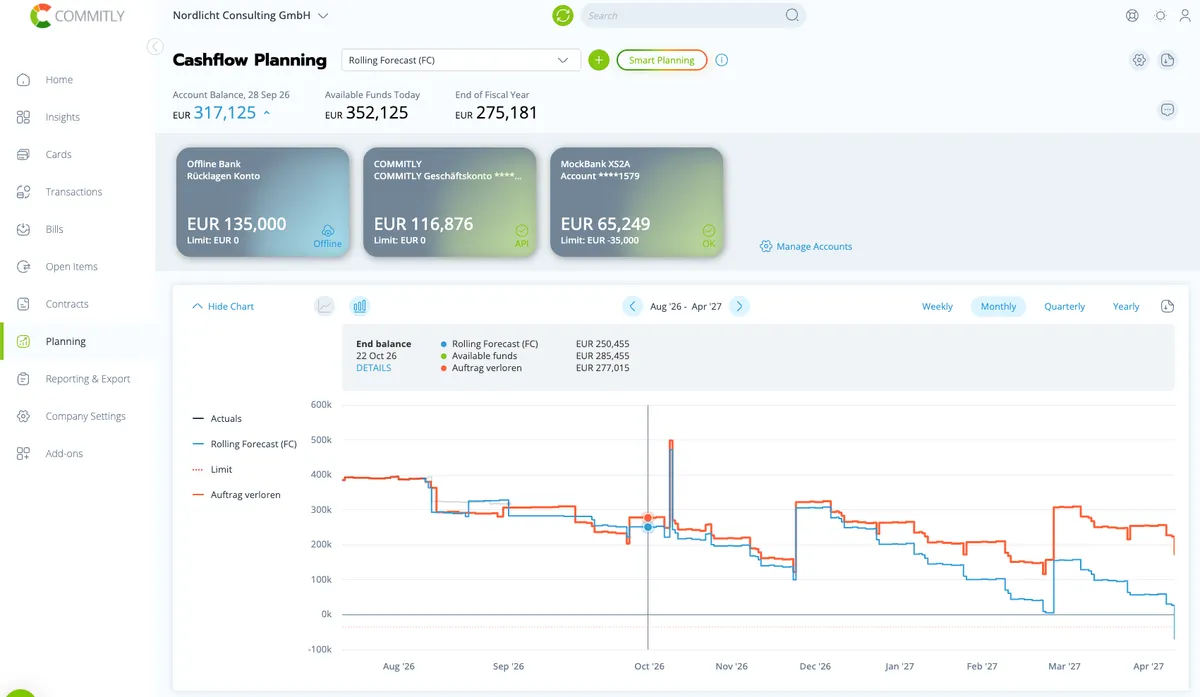
Without a precise view of open items, cash flow quickly becomes a gut decision. With a properly maintained open items list you make outstanding amounts and dates visible and, through forward-looking liquidity planning, you learn what can happen over the next 3, 6 or 9 months. At COMMITLY, the importance and meaning of open items is clear. From now on, you can turn open items into solid decisions.
- Simple & professional cash flow management
- Real-time integrations & direct APIs
- Planning & monitoring in one tool
- Developed by professionals (25+ years)
- Fair, transparent pricing


Frequently asked questions
Open items are all invoices of a company that have not yet been settled. This includes both outstanding receivables from customers (debtors) and outstanding payables to suppliers (creditors).