- Liquidität
Types of cash flow at a glance – these are the differences

Anyone who only looks at a company’s profit often overlooks how liquid, stable or healthy it really is. Cash flow shows how much money actually “flows” through the company and, above all, where it comes from and where it goes. And there is not just one flow of money, there are several types of cash flow. Each of these key figures tells its own story about a company’s day-to-day business, growth and capital structure.
In this article we take a close look at the different types of cash flow, explain what they mean, what to watch out for and why free cash flow in particular is so interesting for many investors.
What is cash flow? Briefly and clearly explained
Before we go into the different types of cash flow, we would like to refresh the definition once more. The term “cash flow” describes the actual flow of money within a company, that is, the sum of all incoming and outgoing payments in a given period. Unlike accounting profit, which also takes into account bookkeeping effects such as depreciation or provisions, it shows how much money is really available.
That makes it one of the most important key figures when it comes to a company’s liquidity and solvency. Even a profitable company can run into difficulty if there are not enough liquid funds available to cover ongoing costs.
In short: it tells you whether and how well a company is financially viable under its own steam, independently of accounting tricks or one-off balance sheet effects.
The three types of cash flow at a glance
A company’s total cash flow can be divided into three broad areas. The individual types of cash flow shed light on different areas of corporate finance, and together they give a complete picture of the cash flows. What matters is where the money comes from and what it is used for.
Operating cash flow (cash flow from operating activities)
Operating cash flow shows how much money the company generates through its core business, that is, from selling products or services, less ongoing operating expenses. These include salaries, rent, material costs or taxes, for example. A permanently positive operating cash flow is a good sign: the company can finance itself under its own steam without depending on loans or asset sales.
Cash flow from investing activities
This type of cash flow covers all payments connected with investments in fixed assets, for example the purchase or sale of machinery, buildings, vehicles or shareholdings. A negative investing cash flow is not necessarily bad, because it can indicate that the company is investing in its future. What matters is whether these investments also generate returns.
Cash flow from financing activities
Cash flow from financing activities shows how the company finances itself, for instance by taking out loans, repaying borrowings, raising capital or distributing dividends. A positive flow of money in this area often means that new capital is coming into the company; a negative one can indicate repayments or distributions. Here, too, the assessment depends on the overall context.
Free cash flow – the room for real decisions
Free cash flow is one of the most meaningful key figures among the various types of cash flow. It gives a particularly precise picture of how much financial room a company actually has left. It shows how much money is really left over after all ongoing costs and investments have been deducted, in other words the amount the company can use freely without relying on external funds.
Free cash flow is usually calculated as follows:
Operating cash flow – investment expenditure = free cash flow
What is left over can be used by the company for repaying debt, distributing dividends, building reserves or funding new strategic projects, for example. Depending on the industry and the company’s stage of development, free cash flow can also be used in different ways: to finance growth at start-ups, say, or to provide stability at established mid-sized companies. The important point: it creates flexibility and reduces dependence on banks or external capital.
For investors this figure is particularly relevant: it shows whether the business model is sustainable and whether value is really being created. A company that regularly generates surpluses that go beyond its investments has genuine financial room for manoeuvre – and in the end that is often more important than pure revenue or profit figures.
Why distinguishing between the types of cash flow matters
While the sum of all cash flows merely shows whether more money came in or went out over a period, the individual types of cash flow give decisive clues about where those funds came from and what they were used for.
An example: two companies could show the same positive total cash flow. But while one of them generated the surplus from day-to-day business, at the other it came from selling assets or from a loan. Liquidity yes – but a completely different starting position.
For investors, lenders and management, the distinction is therefore central:
- Operating cash flow shows how well the day-to-day business is running.
- Investing cash flow offers insight into the strategy for the future.
- Financing cash flow reveals how stable or dependent the capital structure is.
Only by looking at the types of cash flow individually can you judge how solidly a company is positioned, whether investments can be shouldered under its own steam and whether financial bottlenecks are looming.
Types of cash flow in practice: a simple example
To understand how the different types of cash flow interact, a brief look at a practical example helps. Imagine a mid-sized manufacturing company:
- It sells machines and generates revenue of EUR 1,200,000 in the year. After deducting salaries, rent, materials and taxes, an operating cash flow of EUR 300,000 was calculated.
- In the same period the company invests EUR 150,000 in new production facilities. This appears as a negative amount and is calculated as cash flow from investing activities.
- In addition it has taken out a loan of EUR 200,000. This amount feeds positively into the cash flow from financing activities.
The overview:
Type of cash flow | Amount | Interpretation | |
1 | Operating cash flow | +300,000 | Healthy, profitable core business |
2 | Cash flow from investing activities | -150,000 | Reinvestment in future growth |
= | Free cash flow | 150,000 | Available for reserves, debt repayment, dividends |
3 | Cash flow from financing | +200,000 | Debt or equity for further financing |
= | Change in liquid funds | 350,000 | Total change in liquid funds |
This simplified example shows that it is not the bare account balance but the origin and use of the funds that says something about a company’s economic substance. Looking at individual figures in isolation is not enough. Only the composition of the cash flows gives a realistic picture. Every balance sheet analysis should therefore be supplemented – whether for investment decisions, loan negotiations or internal controlling.
Conclusion: reading the types of cash flow correctly means understanding the company
Cash flow is more than just a number in the financial overview: it is a window into a company’s actual economic reality. While profit is often distorted by accounting effects, the flow of liquidity shows how much money is really available and where it comes from. Anyone who understands the individual types of cash flow – operating, investing and financing – and analyses them deliberately will recognise early on whether a company is running a healthy business, over-investing or dependent on external financing. And that is exactly where its value lies: as an early warning system, a basis for decisions and a gauge of sustainable success.
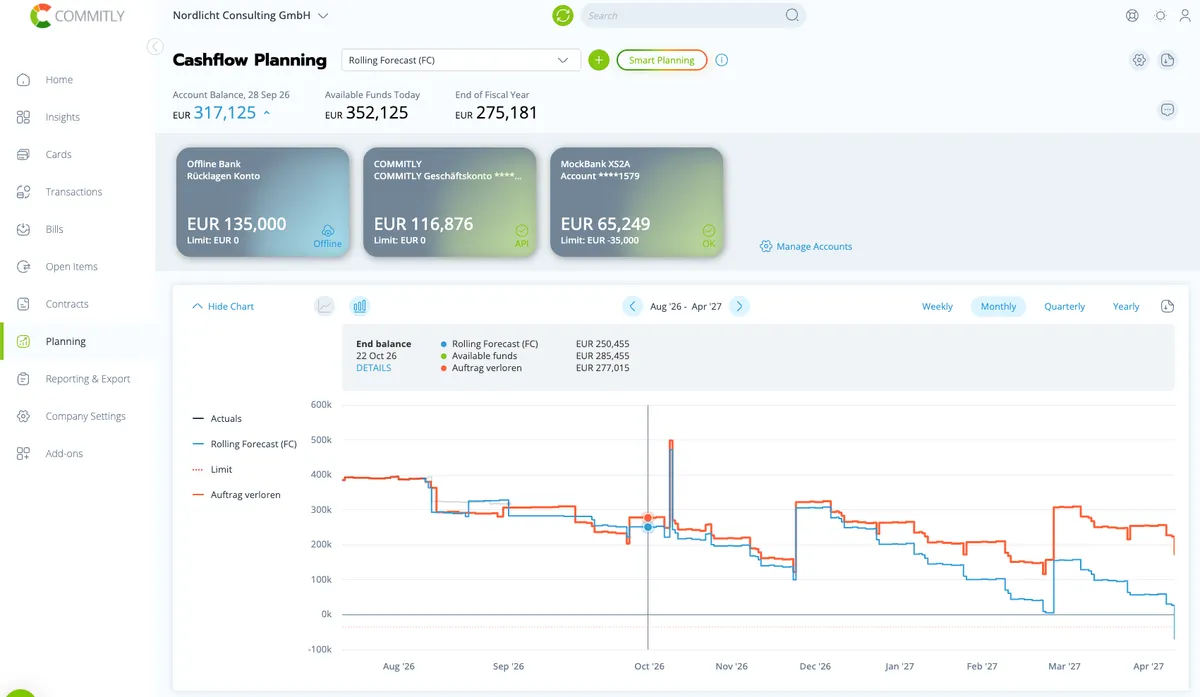
Anyone who reads and plans all cash flows correctly gains deeper insight and makes better decisions.


Frequently asked questions
The three main types are: – Operating cash flow: money from day-to-day business – Investing cash flow: cash flows from the purchase or sale of assets – Financing cash flow: cash flows from loans, capital or dividends. This distinction helps you understand a company's financial position and strategy better.