- Liquidität
Cash flow optimisation for companies: how to improve your liquidity

In the business world, cash flow is of decisive importance. A positive cash flow statement shows that a company has enough cash available to cover its operating costs and investments while building a solid financial base at the same time. But how can companies improve their cash flow? Here are a few tips on cash flow optimisation for companies.
Track your expenses closely
Monitoring your expenses is an important part of cash flow optimisation. Track your expenses closely to see where you can save money. Look at every expense critically and consider whether it is really necessary. Look for ways to cut costs, for example by switching to a cheaper supplier or by doing without unnecessary expenditure, and to increase your efficiency.
An example of cutting costs by eliminating unnecessary expenditure and increasing efficiency could look like this:
- Reviewing and optimising processes: check your business processes for unnecessary steps or overlaps and optimise them to save time and resources.
- Reducing energy costs: check and optimise your energy consumption patterns by using energy-efficient equipment and lighting.
- Reviewing supplier contracts: check your supplier contracts for prices and payment terms and negotiate better conditions where possible.
- Using open source software: review your software spending and consider using open source alternatives to reduce costs.
- Reducing travel costs: review your travel costs and consider alternatives such as video conferences to avoid trips.
These are just a few examples that can be adapted to the specific circumstances of your company. It is important to review your expenses regularly and to look for ways to reduce unnecessary costs and increase efficiency.
Manage your inventory carefully
Inventory is often one of a company’s largest capital investments, and it is important to manage it carefully. Hold only as much inventory as you need to meet your customers’ demand. Make sure you keep accurate records of your inventory and review it regularly to ensure that it has not become obsolete or damaged. If you have excess stock, you should try to reduce or run it down.
Shorten your receivable cycles
The faster you can collect your receivables, the faster your cash flow improves. Make sure you issue your invoices on time and accurately and that you keep track of which customers have overdue payments. Also consider accepting alternative payment methods such as PayPal or credit cards to speed up payment.
Delay your expenditure
On the other hand, you can also try to delay your expenditure to improve your cash flow. Negotiate longer payment terms with your suppliers or try to avoid advance payments. Also consider using leasing or rental agreements instead of buying capital goods, in order to spread the expenditure.
Improve your liquidity
Your company’s liquidity has a major influence on your cash flow. To improve your liquidity, you can try to reduce your inventory or extend credit lines. Another option is to use factoring or leasing to generate cash quickly.
Manage your debt
Debt can be an important part of financing your company, but too much debt can also weigh on your cash flow. Try to reduce your debt burden by negotiating interest rates or consolidating debt. Make sure you make your payments on time and in full to avoid penalties and additional interest.
Monitor your cash flow position regularly
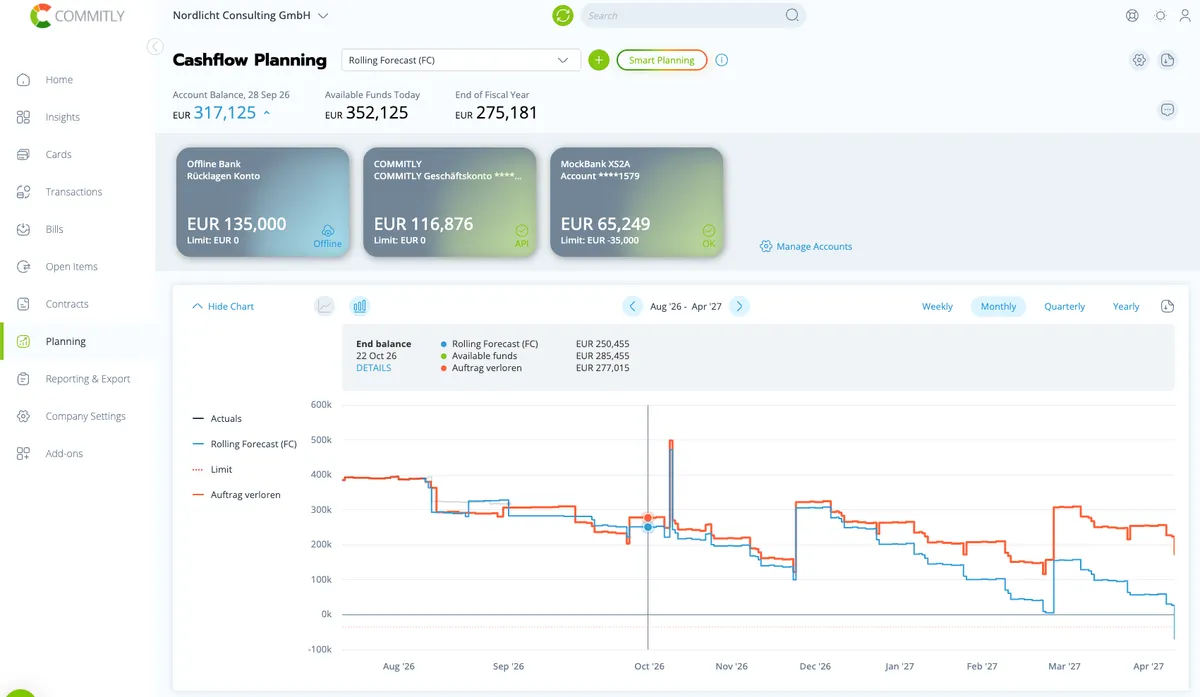
It is important to monitor your cash flow position regularly so that you spot possible bottlenecks early. Make sure you produce an accurate cash flow statement and update it regularly. Monitor your bank statements and compare them with your cash flow statement to identify discrepancies. To do so, also implement effective methods of liquidity forecasting and budget planning in order to anticipate and plan for changes in cash flow. You can make this task considerably easier by using cash flow planning software.
Your cash position — in view every day.
COMMITLY shows balances, open items and forecast in one view, so you spot shortfalls early. You approve and pay invoices in the same system.
Some effective methods of financial forecasting and budget planning are:
- Trend and seasonality analyses: monitor your company’s cash flow trends and seasonal fluctuations and take them into account in your projections.
- Bottom-up planning: create a detailed projection based on project plans and budgets for individual business units or departments. Involve your team in this as well.
- Using cash flow models: build cash flow models that help you predict the effects of different scenarios on your liquidity.
- Using historical data: use your company’s historical data to produce a realistic projection.
- Review and adjustment: review your projections regularly and adjust them when market conditions or business prospects change. Since cash flow, or liquidity, changes continuously, this review can quite happily take place every week.
It is important to use a method that fits the specific requirements and circumstances of your company. Consistent, rigorous financial forecasting and budget planning can help you identify potential problems early and respond to them actively in order to optimise your company’s cash flow.
We have described why, and every aspect of cash flow planning, here.
Plan your investments carefully
Investments can be a major burden on your cash flow, but they are also necessary to grow your company. Plan your investments carefully and make sure you have enough cash to finance them. Consider alternative financing options such as crowdfunding or leasing to lower your investment costs.
Identify and manage risks
Identify and keep an eye on everything that can have a negative effect on cash flow, such as currency fluctuations or changes in demand for products or services. Consider what impact each individual risk could have on your company and develop counter-strategies. Avoid risks with too great an influence on your company, such as dependence on a single supplier. These risks are also referred to as concentration risk.
Use expert advice
If you are having difficulty optimising your cash flow, you should turn to a financial adviser or accountant. These experts can help you analyse your cash flow and identify opportunities for optimisation. They can also help you implement strategies for improving your cash flow.
Conclusion
An optimised cash flow position is decisive for a company’s success. By carefully managing inventory, expenses, receivable and debt cycles, liquidity, investments and accounting, and through regular monitoring and the use of expert advice, companies can improve their cash flow and strengthen their financial base.