SOFTWARE COMPARISON
Cash flow software
compared
compared
Which solution fits you? Fifteen vendors with sources, ten questions for every demo, and the figures we can evidence.

Check for yourself
Figures, not tick boxes
COMMITLY is sometimes described differently elsewhere. These figures come from the product and from our pricing page.

5,000+ banks
Via PSD2 through several regulated banking aggregators, in every edition. FinTS from Business, EBICS as an add-on, included in Enterprise.
Planning in every edition
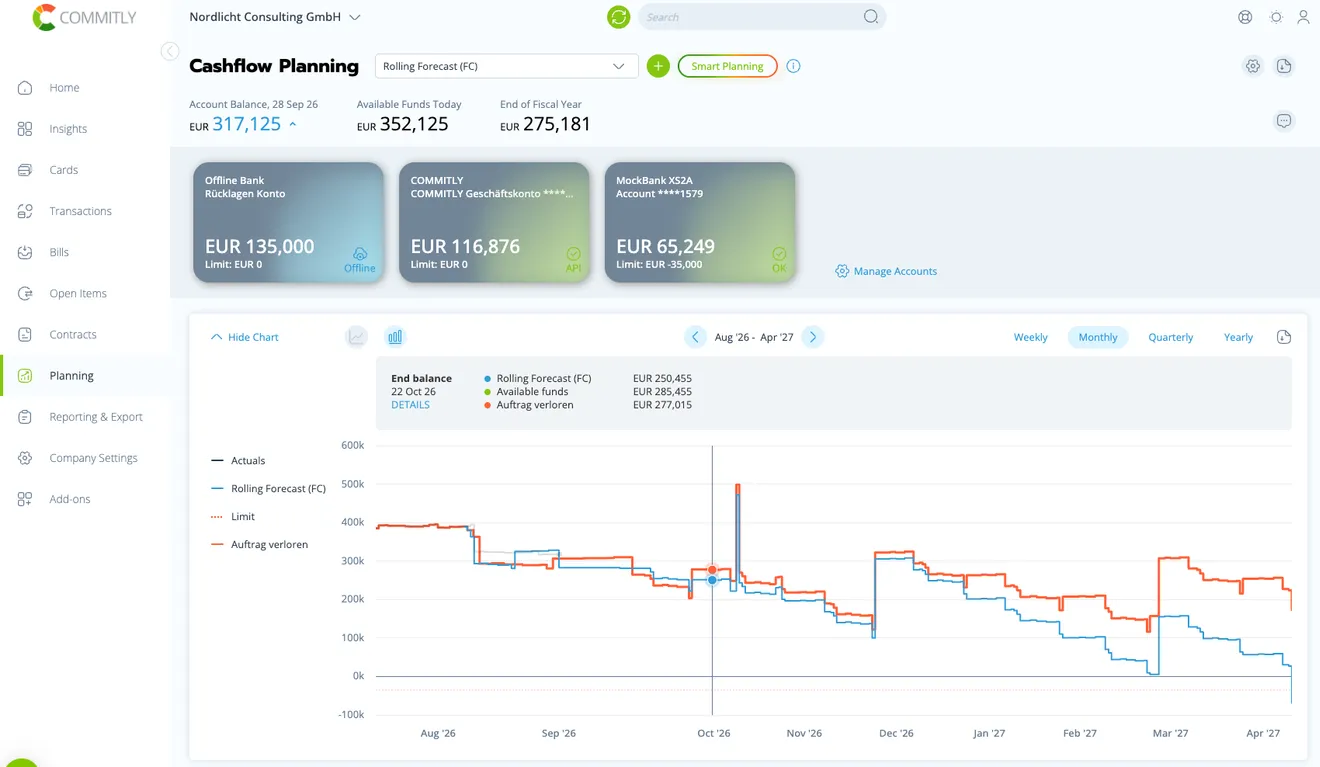
A professional planning system that is easy to use: rolling forecast, dynamic scenarios, plan versus actual. No surcharge.
Open items in the forecast
Receivables and payables with due dates, matched automatically against the bank, including partial and bulk payments.
From invoice to payment
OCR capture, approval policies with four-eyes rule, payment as a SEPA XML file, directly via PSD2 (Pay by Bank) or via EBICS.
ISO/IEC 27001:2022
Certified, hosting in Germany, data processing agreement on request.
From EUR 55 a month
Fair and transparent, with attractive discounts on 12- and 24-month terms. 14-day free trial, no credit card. See pricing
Vendor list 2026
Cash flow planning software: 15 vendors compared
- Grouped by company size, no ranking
- Cash flow planning and financial planning clearly separated
- Every statement sourced from the vendor itself
- Reviewed every quarter
For the self-employed and small businesses
- finban
- Qonto
- Trezy
For SMEs and mid-sized companies
- Agicap
- COMMITLY
- Companyon
- Embat
- helu
- re:cap
- Tidely
For large corporations
- Jedox
- LucaNet
- Nomentia
- SAP
- TIS
As of: 27 September 2026
Comparisons
COMMITLY and other vendors, side by side


Tidely alternative: comparison, reviews and prices
Read more »Learn more about Tidely alternative: comparison, reviews and prices
Agicap alternative: professional financial management without overhead
Read more »Learn more about Agicap alternative: professional financial management without overhead
Liquidity management software for mid-sized companies: what it does, what it costs, which providers count
Read more »Learn more about Liquidity management software for mid-sized companies: what it does, what it costs, which providers countChecklist for every demo
Ten questions that decide it
Put them to every vendor you look at. To us as well.
The fastest answer to all ten questions: your own figures. 14 days free, no credit card.
Try it free now!Where do the actual figures come from?
From the bank account, or from a spreadsheet someone maintains? Anything entered by hand is stale between two meetings.
Do open items feed the forecast?
Without receivables and payables a plan is an estimate. With them it becomes a calculation.
Scenarios at no extra cost?
Can you run a scenario without overwriting the plan — and is that included in the price?
Is invoice approval part of it?
If not, you need a second tool and gain one more break in the chain.
Can you steer the cash flow too?
Meaning: trigger payments straight from the software instead of just watching? Otherwise you plan in one tool and pay in another.
What about several entities?
From which edition does the consolidated view exist, and what does it cost?
Can the software grow with you?
Do invoice approval, payments, cards or reports come as add-ons when your company grows — or does growth mean switching systems?
Is there an open API — and since when?
Publicly documented, read and write? Ask for the documentation and how long customers have been using it day to day.
How does the software use AI — and can your own AI connect?
Does the AI suggest and you approve, or does it decide on its own? And is there an MCP server that lets your AI assistant work directly with your financial data?
Which evidence exists?
A certificate has an issuing body and a scope. Everything else is self-declaration.
The honest flip side
When cash flow software is close to mandatory
Six situations where the question is no longer whether you need a tool, but which one.
You build Excel models at the weekend
And value your own time at zero. Price it at what it is really worth, and the software is always the smallest budget.
Someone on the team built a brilliant spreadsheet
Then your cash flow planning depends on one person. Who takes over when they are ill, on holiday or leave the company?
Someone built a cash flow tool with AI
Then you are now a software operator: bank connection, security, updates, data protection. AI makes building quick; running it stays with you. More on this: Build your own cash flow tool
Your business fluctuates strongly
Seasonal peaks, large single orders, long payment terms: then you need precise planning so you do not run into a self-inflicted liquidity squeeze.
Your financing headroom is small
Little reserve, credit lines used up: as management you have to be able to spot a crisis early. Otherwise a liquidity problem becomes a question of personal liability. The usual framework for this is a rolling 13-week plan.
Your bank wants to see a cash flow plan
In a loan meeting, when a credit line is renewed or when covenants apply. A plan built from real account balances convinces more than a spreadsheet put together the night before. More on this: Cash flow planning for your bank
COMMITLY alternative
When COMMITLY is not for you
That belongs on a comparison page too.
You only want to see the balance
If you do not plan, you do not need a cash flow platform. Online banking will do.
You need bookkeeping and retention
COMMITLY is not that, and it is not GoBD compliant. Booking and retention happen in DATEV, Lexware Office or sevdesk. How the two work together: Cash flow planning with accounting software.
You need treasury in the corporate sense
Currency hedging, interest management, cash pooling across dozens of entities: specialised treasury systems exist for that.
Nobody has the time
A cash flow plan lives on somebody looking at it once a week. Without that person, even the best software will not help.
Your accounts are in the US or Asia
COMMITLY connects banks in the EU. If your main accounts sit outside Europe, an internationally oriented treasury solution will serve you better.

Ready for your cash flow platform?
Frequently asked questions
The question has no general answer, because vendors serve different company sizes. Ten things decide it: where the actual figures come from, whether open items feed the forecast, whether scenarios can be run, whether invoice approval is included, whether payments can be triggered directly, what happens with several entities, whether the software can be extended, whether there is an open API, how it uses AI and whether your own AI can connect — and which evidence actually exists. Put those ten questions to every vendor and you get a sound shortlist instead of a tick-box table.