- Liquidität
Signa – cash flow planning as it should not be done

Well thought-out cash flow planning is the foundation of a successful company. But as the insolvency of the Signa Group impressively demonstrates, serious mistakes in this area can have grave consequences. In the following we examine the most important aspects of professional cash flow planning and illustrate how the Signa Group failed to put them into practice.
What is cash flow planning and why does it matter?
Cash flow planning is the process of ensuring that a company remains able to pay its debts. Future incoming and outgoing payments are forecast in order to identify bottlenecks in good time and counteract them. Sound cash flow planning should:
- Be detailed and robust: realistic assumptions about income and expenditure form the basis.
- Be audit-proof: documentation and traceability are essential.
- Be strategically designed: a clear separation between short-term and long-term planning is required.
- Ensure flexibility: scenario analyses help to anticipate different developments.
The Signa Group’s mistakes: a textbook example of failed cash flow planning
The insolvency of the Signa Group revealed blatant weaknesses in liquidity management, with potentially serious consequences for those involved. The following mistakes have so far been identified by the insolvency administrator in the insolvency proceedings:
1. “Beer mat calculations” instead of professional planning
Instead of a robust liquidity overview, the Signa Group relied on so-called “beer mat calculations”. See here. These “calculations”, which existed in rudimentary Excel formats, contained:
- Arbitrary transfers of value with no legal basis from companies outside the group.
- Unsecured assumptions about the availability of free liquidity within subsidiaries.
- A lack of transparency and traceability.
- Missing scenarios (what-if) and genuine worst-case considerations

Figure “beer mat calculation” © News
The lack of care and structure in the cash flow planning in no way met the requirements placed on a large corporation.
2. Improper use of funds
Although Signa Prime Selection AG itself had considerable liquidity problems, according to the insolvency administrator around EUR 252 million was transferred to Signa Prime Holding GmbH in 2023 alone, in the form of subordinated – that is, unsecured – upstream loans. These payments were made:
- Despite the known financial difficulties of the receiving company.
- Without any economic basis, which puts those responsible in a poor light.
- Apparently as preferential payments to closely associated advisers, which further substantiates the assumption – supported by statements from investors – that the adviser was acting as a de facto managing director.
3. Early warning signals ignored
The Signa Group’s economic problems did not arrive suddenly: according to reports, financing difficulties must have been apparent to the members of the management board as early as 2019. Even so, no countermeasures were taken. According to the insolvency administrator, an insolvency application should have been filed by the end of the first quarter of 2022 at the latest. The failure to fulfil that obligation ultimately led to the delayed filing for insolvency alleged by the administrator.
4. Absent supervision
It is not only the management board that bears responsibility in such situations, but the supervisory board too. According to the accusations made by the insolvency administrator, the entire supervisory board of Signa Prime Selection AG failed to supervise the management board properly and to press for an insolvency application in good time.
Possible consequences of failed cash flow planning for the acting bodies
Mistakes in cash flow planning can place a heavy burden not only on the company but also personally on the people responsible on the management and supervisory boards. The consequences include:
1. Liability claims
Members of the management and supervisory boards are personally liable for damages resulting from deficient planning or from delayed filing for insolvency. In the case of the Signa Group, the insolvency administrator put the liability of those responsible at around EUR 1 billion. This liability is joint and several, which means that all members must answer collectively for the total debt.
2. Criminal consequences
A late insolvency filing can trigger criminal investigations. Those responsible can be prosecuted for delayed filing for insolvency or for breach of trust, which can result in substantial fines or even custodial sentences.
3. Loss of reputation
The personal reputation of those responsible can be massively damaged by an insolvency. This makes future professional activity more difficult, particularly in positions of responsibility.
4. Reclaiming of remuneration
In the event of an insolvency, fees and bonuses already paid to members of the management and supervisory boards can be reclaimed. That also happened at the Signa Group, where fee payments have already been partly reclaimed successfully.
Learning from the mistakes: how professional cash flow planning works
To avoid such scenarios, companies should pay attention to the following points:
1. Establish binding standards
Professional cash flow planning requires binding standards for data preparation and documentation. Traceable methods and software solutions such as COMMITLY should be used.
2. Build in scenario analyses
“Worst-case” scenarios should be worked out in detail – not just on a “beer mat”. Scenario analyses help you take well-founded decisions.
3. Define clear responsibilities
The roles of the management board and the supervisory board in monitoring liquidity must be clearly defined. Regular reports and independent audits create transparency.
4. Set up early warning systems
A robust early warning system helps to identify liquidity bottlenecks in good time. Automated tools can help to quantify risks — an AI-supported analysis flags anomalies before they become visible in the monthly accounts.
5. Bring in external expertise
Particularly where company structures are complex, the expertise of external advisers should be used to put planning and control on a solid footing. Technically, that calls for a consolidated view across all companies — not one spreadsheet per subsidiary.
Conclusion: do not underestimate the importance of cash flow planning
The insolvency of the Signa Group shows what consequences inadequate cash flow planning can have. Professional liquidity management is not only essential for a company’s stability, it is also a legal obligation.
Companies of every size should make sure that their cash flow planning is robust, transparent and sustainable. Because mistakes like those of the Signa Group are avoidable – provided the subject is approached with the necessary seriousness and professionalism.


Rolling forecast with plan-actual comparison — see shortfalls early.
Try it for free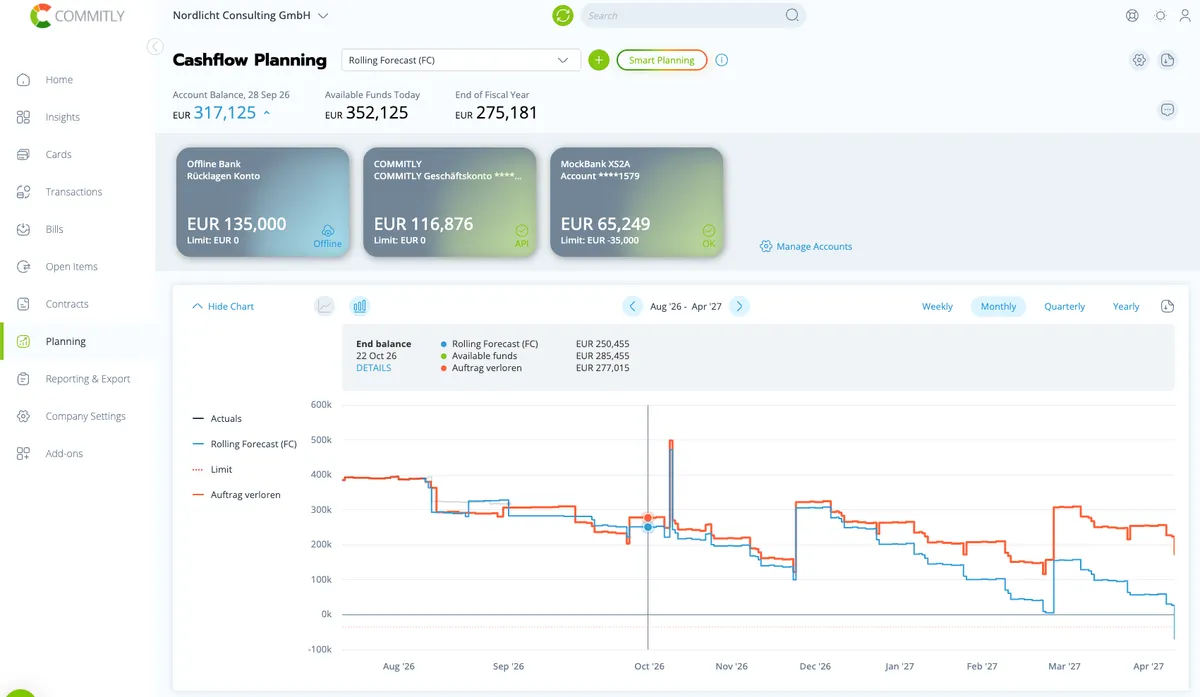

From reading to doing
Robust, transparent, traceable: COMMITLY plans your liquidity from the real account movements — across all your companies.