- Liquidität
Tip: instruments for short-term and long-term cash flow planning
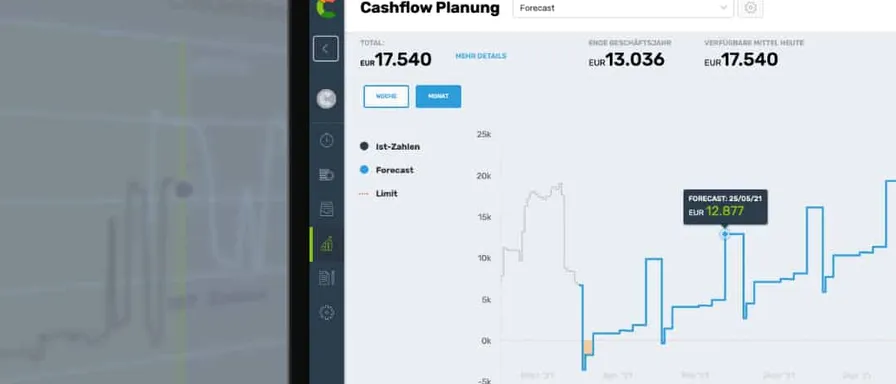
Cash flow planning, or cash flow management, is one of the most important tasks of company management. The challenges and approaches differ according to the economic environment, business model, industry and company size. One essential aspect is also whether the cash flow planning is short-term, medium-term or long-term. In this article we give an overview of which means of cash flow planning are available in the short, medium and long term and how important up-to-date data is as the basis for cash flow planning.
Short-term cash flow planning: payment approvals and cash pooling
Short-term cash flow planning over a horizon of a few days can play an important role in some situations. For companies with fast payment flows (e.g. online retail), or for companies with strongly fluctuating expenditure, the daily monitoring of payment approvals at particular times can become important.
The tighter the funds available each day, the more important the short-term component of cash flow planning becomes.
This is where so-called cash pooling can help. The principle behind this short-term measure for preserving liquidity is simple: if a company’s account balance threatens to slip below zero, the balance is temporarily evened out by the positive cash holdings of a subsidiary belonging to the company. Cash pooling is essentially operated within companies and groups that hold funds in distributed accounts which can be balanced against one another. This makes it possible to avoid overdraft interest or current account credit.
But it is not only large groups that can benefit from this instrument of cash flow planning. Public institutions, local authorities or state-owned utilities can also use cash pooling intelligently to avoid short-term payment difficulties by letting free money flow to wherever it is currently needed.
A modified form of cash pooling can, however, also be carried out within a single company on the basis of reserve accounts (internal cash pooling). When sufficient liquidity has been generated operationally, liquidity that is not strictly required is transferred to a reserve account. If liquidity is needed again, for example because of larger supplier payments or investments, money can be transferred back from the reserve account to the operating account.
In the real estate sector, the so-called waterfall procedure is also popular in this context. Here the main components – rent, operating costs, investments (so-called capex accounts) and debt service – are separated across different accounts. When the rents come in, they are transferred to the debt service, capex and operating cost accounts. If investments are needed, they are paid from the capex account.
Medium-term cash flow planning: reviewing open items (receivables and payables)
Medium-term cash flow planning looks at the cash holdings, or liquid funds, of the coming weeks up to a few months. Open item management is of central importance in this area. On the incoming payments side it is above all the open receivables that should be examined closely:
- Which customers have not yet paid? Which invoices are currently open? A list of all open receivables with their payment terms provides a first overview here.
- How high is the probability of an invoice default? An ageing schedule of receivables can help to estimate default risks and to forecast the realistically expected incoming payments more accurately.
- Which payment terms and conditions have currently been agreed with the customers? By granting early payment discounts or agreeing instalments and part payments, incoming payments can often be realised earlier.
On the outgoing payments side, improvements in cash flow planning can be achieved by reviewing all open invoices. Can you perhaps pay suppliers, subcontractors or freelancers later? In extreme cases, can instalment payments be agreed? Anyone who actively approaches their creditors here can often secure decisive advantages.
Long-term cash flow planning: cash flow optimisation as part of the financial strategy
Anyone who wants to run their company “high on cash” over the long term should anchor cash flow planning as an essential part of the company strategy. All entrepreneurial decisions should be taken with a view to their effect on liquid funds. The goal should be to accelerate the so-called cash conversion cycle.
How does that work?
Have you ever considered how long it takes for a euro you have paid out for staff, materials or other expenses to come back to you as an incoming payment? The key figure of the cash conversion cycle calculates exactly that value. The smaller it is, the better your company is positioned in terms of cash flow planning.
To keep the cash conversion cycle as short as possible, your cash flow planning can start at three points:
- Push back the timing of outgoing payments
- Shorten storage times – reduce inventory
- Realise incoming payments earlier and more regularly
Important: plan with scenarios
Scenarios play an important role in cash flow planning. Experience naturally plays an important part in this context, but it should complement doing the maths rather than replace it. What-if considerations should be calculated regularly, but above all they should also be talked through and discussed. In doing so, you should think in every direction:
What can cause liquidity bottlenecks, and when, and how do you react?
To open up sustainable room for manoeuvre in every direction in your cash flow planning, you should seek contact early on with banks and potential financial backers who can step in should a sudden liquidity gap arise. The terms for such bridging arrangements are also best negotiated while no genuine emergency has yet occurred.
How can you preserve surplus liquidity or invest it back into the company?
What applies to the worst case should also be planned for the best case. The question for cash flow planning is then: what do you do if, over the long term, a large cash balance accumulates that is not needed for day-to-day operations? This calls for the right investment and asset strategies. Where liquid funds are high in the short term, internal cash pooling into reserve accounts is a good option, as discussed.
The prerequisite: up-to-date data and the right instruments
No matter whether you want to plan your liquidity in the short, medium or long term: the basis for any good plan is reliable and, above all, up-to-date data.
The problems often seem very large:
- Too few staff in the finance department (or no finance department at all)
- The bookkeeping is done once a month
- The tax adviser’s report (business management analysis, BWA) arrives at the earliest 6 weeks after the end of the month
- Open receivables and payables are only inadequately monitored in many companies.
The causes of these problems are the high complexity of finance and, in part, outdated instruments – particularly in mid-sized businesses. That is why Excel is still often used for cash flow planning. But filling in Excel spreadsheets is time-consuming and error-prone. Unfortunately, the quality of the forecasts produced from Excel is also inadequate.
An all-in-one solution for the finance department is tempting, but far too much effort. Processes have to be adapted, interfaces defined and staff trained. The great advantage of digitalisation is the ability to use specialised tools where they are needed and then to connect them. That way you create your own “very personal SAP” at a fraction of the cost.
COMMITLY is just such a solution specialising in cash flow planning. Connect your bank accounts and start cash flow planning for your company within a few hours.