- Liquidität
Financial controlling – the compass for financial stability

For a company to understand its figures better and react to developments in good time, financial controlling is essential. It provides financial stability, supports decision-making and creates certainty. The following article presents important tasks and methods and shows practical examples. You will also learn how modern tools such as COMMITLY make it easier for you to get started with professional financial controlling and to handle all the processes involved without complications.
The essentials in brief – early warning system & securing liquidity
- Definition: financial controlling = a sub-area of controlling with a focus on liquidity, solvency & financial management. It links operational figures with strategic planning.
- Objectives: securing liquidity, transparency about cash flows, early risk detection, a better basis for management decisions
- Functions/tasks: cash flow planning, cash flow management, forecasts, budgeting, variance analyses, working capital optimisation, reporting and communication
- Benefits for companies: an early warning system for bottlenecks, greater planning certainty, a better negotiating position, clear responsibilities
Table of contents
- What is financial controlling? Definition, objectives and benefits at a glance
- From stress to controllability: benefits and impact for liquidity and planning
- What does a financial controller do? Important financial controlling tasks at a glance
- Important key figures in financial controlling explained simply
- Data sources & tool stack: how reliable financial controlling comes about
- Common mistakes in financial controlling and how to avoid them
What is financial controlling? Definition, objectives and benefits at a glance
Financial controlling is a sub-area of corporate controlling. Here the focus is primarily on financial management. Financial controllers pursue the goal of securing a company’s liquidity and profitability and thus provide financial security.
In short, in this area data is recorded and analysed and, on that basis, plans and a basis for management decisions are drawn up. Controlling therefore links the operational with the strategic perspective, in order to keep both short-term solvency and long-term development in view at all times.
In large companies and groups in particular, there are many key figures, some of which can seem confusing. The staff in finance and controlling make these figures easier to understand, so that possible opportunities and risks are identified early. In the SME segment (small and medium-sized enterprises) in particular, modern tools such as COMMITLY are helpful here, supporting the analysis and creating transparency in real time.
Key benefits of financial controlling:
- Timely identification of liquidity bottlenecks
- A sound basis for decisions on investments and financing
- High planning certainty thanks to valid forecasts
- Easy communication and collaboration with investors, banks and stakeholders
- Provision of structured financial data to relieve the burden on management
From stress to controllability: benefits and impact for liquidity and planning
The following scenario from the SME segment is intended to illustrate how helpful operational financial controlling can be: a company generates stable revenue. But its cash flow planning is tight, because supplier invoices, wages and running costs leave hardly any room for manoeuvre. Shortly before an upcoming meeting at the bank, uncertainty grows.
This is where financial controlling comes in. It creates a transparent overview of all incoming and outgoing payments, identifies possible bottlenecks in the coming weeks and draws up appropriate measures to counteract them. The result: financial stress goes down and management is more capable of acting and more efficient.
The following areas of the company benefit from it:
- Management takes decisions quickly and is better prepared for meetings with the bank.
- CFOs and the finance function improve forecast quality and produce better scenarios and financing arrangements.
- Controllers identify variances early and steer against them accordingly.
- Accounting is more structured, because open items, payment plans and posting data are available more transparently.
- Sales and revenue teams have a better understanding of how they influence cash flow.
- Team leads can manage their budgets more precisely and have their spending better under control.
This results in the following concrete benefits:
- An early warning system for liquidity bottlenecks
- Better working capital (DSO, DPO & inventory)
- Better decisions on investments and hiring
- Rolling forecasts and scenarios (best, base & worst)
- Standardised reporting for greater focus
- A stronger negotiating position with banks and suppliers
What does a financial controller do? Important financial controlling tasks at a glance
The fundamental task of financial controllers is to translate a company’s figures into decisions. In doing so, they ensure liquidity, create transparency and manage the entire financial cycle. Only in this way is it guaranteed that management always looks ahead. The most important tasks include above all:
- Cash flow planning: weekly and monthly recording of incoming and outgoing payments. This identifies bottlenecks, secures solvency and triggers appropriate measures early on.
- Rolling forecast: regular updating of forecasts, incorporating new information. This makes variances visible more quickly.
- Reporting & management pack: preparation of compact reports focusing on the decisive KPIs, cash and measures. They are presented clearly, are comparable and are decision-oriented.
- Budgeting & target system: top-down targets and bottom-up plans mesh together. Assumptions are documented in order to produce realistic annual budgets.
- Working capital management: optimising DSO, DPO, DIO and CCC. The aim is to release tied-up capital and improve cash flow. (More on the key figures below.)
- Variance analysis & managing measures: carrying out target/actual comparisons, identifying causes, defining measures and setting deadlines.
- Scenario & sensitivity analyses: simulating best/base/worst case and testing levers in the process (revenue, margin, costs, interest). This quantifies risks and prepares options for action.
- Communication with banks and financing: providing standardised documents, reviewing financing structures. The aim is to create better negotiating positions and planning certainty.
Important key figures in financial controlling explained simply
KPIs (key performance indicators) are measurable figures that form the foundation of financial controlling. They show whether a company is solvent and how efficient and profitable it is. They therefore form the basis for subsequent fact-based decisions.
Term | Explanation |
Operating cash flow (OCF) | Measures whether the core business generates liquidity. It shows how the company's actual solvency stands. |
Cash runway | Shows how long the available funds will be sufficient to cover running costs. It serves as an important early warning indicator. |
Cash conversion cycle (CCC) | How long is capital tied up in current assets? The shorter the period, the better for cash flow. |
Days sales outstanding (DSO) | How quickly do customers settle their invoices? The lower the figure, the more efficient the receivables management. |
Days payables outstanding (DPO) | The average time until suppliers are paid. The longer the terms, the more liquidity is preserved. |
Days inventory outstanding (DIO) | How long do goods sit in the warehouse? Short storage times increase the room for manoeuvre on liquidity. |
Incidentally: in addition to the key figures shown above, such as cash flow, CCC or DSO, classic earnings figures such as EBIT or ROI also play a role. They show how profitable a company is. Controlling, on the other hand, ensures that sufficient liquidity is available to generate those earnings in the first place.
Data sources & tool stack: how reliable financial controlling comes about
Data quality and how up to date the data is also play a decisive role. Providing data in real time reduces uncertainty and makes forecasts more robust. The data sources, with their respective requirements, include among others:
- Banking/accounts: figures updated daily (challenging where there are several banks and IBANs).
- Accounting (e.g. LexOffice or DATEV): management of open items, receipts and categories. Period-end closings can cause delays here.
- ERP/CRM: management of orders, pipeline and payment terms. Silos and inconsistent data maintenance can arise.
- Payroll: contributions and payroll runs; possible problems: cut-off dates and seasonal fluctuations.
- Further data sources: exchange rates, interest rates, covenants.
When it comes to organising all this efficiently and clearly, modern tools such as COMMITLY provide support. With the help of automated integrations and direct API connections, accounting, bank accounts and other systems are connected and synchronised automatically. This saves staff from copying data manually and does away with error-prone Excel lists.
Rolling forecasts and scenarios can also be created with just a few clicks. This puts you in a position to carry out “what-if” analyses without having to maintain complex spreadsheets. On top of that, open items are presented transparently, so that bottlenecks are identified more quickly and appropriate measures can be initiated.
With COMMITLY you combine these and other features in an intuitive interface and master every challenge. Link banking and accounting in real time, structure cash categories and produce professional reports.
Common mistakes in financial controlling and how to avoid them
Even in a well-organised company, mistakes can creep into financial controlling. Often this is not down to a lack of knowledge but rather to incomplete data, missing routines and too much Excel chaos. But if you rely on clear structures and the right tools, problems of this kind are easy to avoid.
Here are some classic mistakes and the corresponding solutions:
- Focusing only on the P&L (profit and loss account): profits do show success, but they say little about solvency. So always keep cash flow planning in mind.
- Outdated or manual data sources: these can create uncertainty. It is better to rely on API integrations with real-time data.
- Unclear responsibilities: processes and variances are often left unattended. Every situation and every measure needs a member of staff in charge and a due date.
- No rolling forecast: if only annual budgets are drawn up, that can lead to delayed reactions. So it is better to rely on monthly updates and to build in appropriate scenarios.
- No visualisation: especially in larger companies, the figures are often hard to take in. Dashboards with clear figures and cash flow categories help here.
Financial controlling provides an overview, planning certainty and well-founded decisions. These are the basis for sustainable business success. Only those who have their cash flows under control have a clear view, can act with foresight and stay calm. You can achieve all of this with COMMITLY – the tool for professional financial management. It is easy to use and shows your data in real time. Would you like to find out more? Get in touch now and try it free of charge!


Plan-actual comparison and forecast, updated daily from your accounts.
Try it for free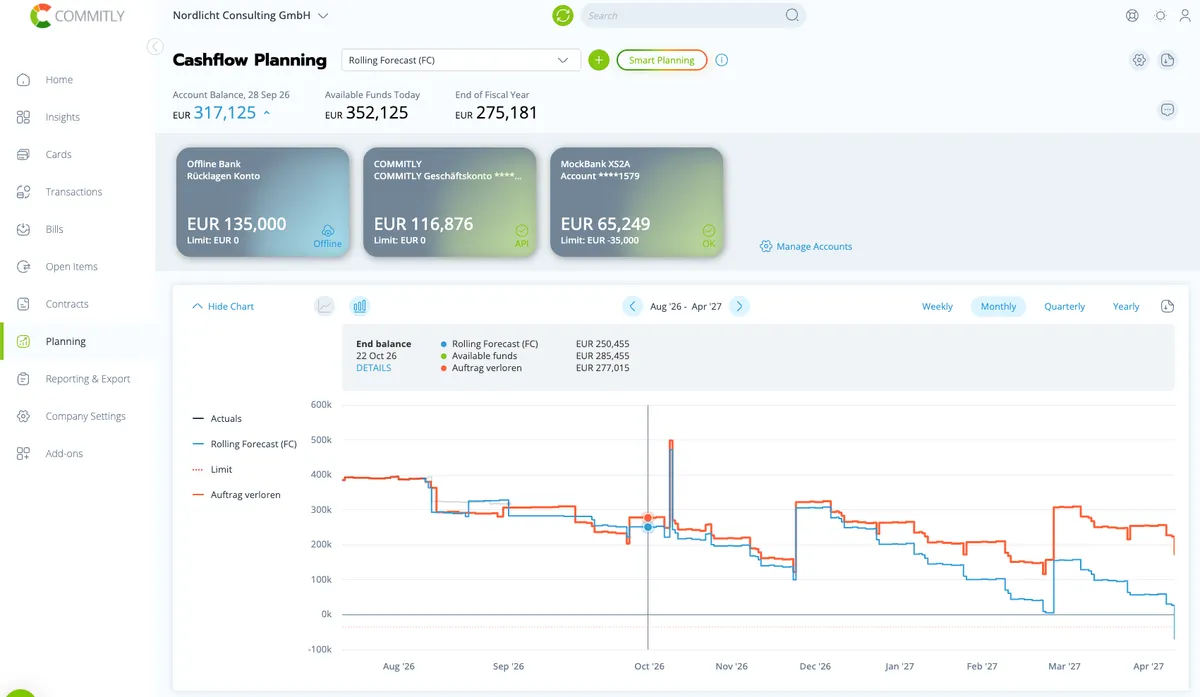
Frequently asked questions
It is a sub-area of corporate controlling that focuses on managing and monitoring a company's financial situation. The aim is to ensure liquidity, profitability and financial stability.