- Liquidität
Internal financing – definition, examples, options and advantages

When you think of corporate financing, the first images are often bank meetings, loan applications or investors. Yet many companies underestimate a source that is immediately available and often inexpensive: internal financing. Instead of raising money from outside, capital from the business itself is used for investments, growth or liquidity. For SMEs, founders and freelancers in particular, this type of financing is a strategic option that creates independence and room for manoeuvre – without interest costs and external control mechanisms.
The key points:
- Definition: financing from your own resources such as profits, reserves, depreciation or working capital.
- Distinction: an alternative to external financing with loans or investors.
- Advantages: no interest, greater independence, a stronger equity ratio.
- Disadvantages: dependent on earning power, limited funds for large investments.
- Practical examples: a bakery invests its profits, a metalworking business uses its reserves, an IT startup reinvests its surpluses
- Conclusion: this form of financing is flexible, inexpensive and strengthens companies in the long term – an important building block, especially for SMEs and founders.
Table of contents:
- Internal financing – definition, examples, options and advantages
- What exactly is internal financing?
- Internal financing vs. external financing – distinction and application scenarios
- The various options for internal financing
- Self-financing
- Internal financing through reserves
- Depreciation as internal financing
- Working capital optimisation & receivables management
- Internal financing and equity financing – how are they connected?
- Internal financing vs. debt financing – advantages and disadvantages compared
- Concrete everyday scenarios
- How to plan and review internal financing realistically
- Tools and processes – how COMMITLY makes internal financing visible
- FAQ
What exactly is internal financing?
Internal financing refers to nothing other than financing processes in which the capital required does not come from external lenders but from the company itself. Typical sources are retained profits (self-financing), reserves, depreciation equivalents or working capital funds deliberately released. In short: it is the use of the company’s own financial potential, generated within the business, to finance investments or strengthen liquidity.
What matters: internal financing reduces dependencies and can strengthen the equity ratio. At the same time it depends on the company’s earnings situation and its accounting framework.
Internal financing vs. external financing – distinction and application scenarios
As a reminder: external financing means obtaining capital from banks, suppliers, investors or public funding programmes.
The advantage: quick availability of funds and economies of scale.
The disadvantage: interest and repayment burdens, participation rights or covenants.
In practice, a deliberate mix often makes sense: internal financing for stability and the company’s own share, external financing for rapid growth or larger investment requirements.
The various options for internal financing
Self-financing
With self-financing (careful: this does not mean equity financing) profits remain in the company instead of being distributed. These retained profits increase equity and are available for investments. For entrepreneurs this is a very solid source, because it strengthens the balance sheet and no external conditions have to be met. Good predictability is decisive: only those who build reserves systematically can use self-financing as a viable strategy.
Reserves
Reserves are funds deliberately set aside that serve as a buffer. They include statutory reserves, free reserves and hidden reserves. Reserves can be used flexibly over time for investments or liquidity fluctuations. What matters is that they are built up in a documented way and cleanly in the accounts, so that the funds are available on the balance sheet.
Depreciation
Depreciation is an accounting expense for the wear and tear of fixed assets. In practice that means: the expense reduces profit, but does not directly affect liquidity. Because depreciation reduces profit, less tax is paid. That saves liquidity, which stays in the company and can be reinvested. This is why classic financing theory says: depreciation “releases funds”.
Working capital optimisation & receivables management
Another lever is the management of current assets: faster collection of receivables, longer payment terms with suppliers and optimised stockholding release liquidity. This form of internal financing can be controlled operationally and can take effect in the short term.
Internal financing and equity financing – how are they connected?
When internal financing takes the form of retained profits, it increases equity – which makes internal financing at the same time a form of equity financing. A clear distinction matters: not every addition to equity is internal financing (for example, when a shareholder contributes equity, that is external equity). Internal financing does, however, strengthen independence and creditworthiness in the long term.
Internal financing vs. debt financing – advantages and disadvantages compared
Advantages of internal financing:
- No interest costs
- No contractual obligations towards third parties
- Improvement of the equity ratio and the rating situation
Disadvantages:
- Dependent on earning power and results
- Possibly limited funds for large investments
Advantages of debt financing:
- Rapid raising of capital
- Leverage effect on growth
Disadvantages:
- Interest and repayment burdens
- Dependencies and possible co-determination by lenders
Concrete everyday scenarios
Practical examples make clear how versatile this form of financing can be. A small business owner invests accumulated profits to equip her bakery with a new line of ovens – entirely without a bank loan. A family-run metalworking company modernises its machinery from reserves, while a profitable IT startup reinvests surpluses in order to hire developers and scale quickly. The examples show that this type of financing is practicable in almost every industry and gives companies more independence.
How to plan and review internal financing realistically
A realistic liquidity plan, scenario analyses (3/6/12 months) and a transparent overview of the balance sheet and results are prerequisites. Check: which profits are actually available (after tax and provisioning requirements)? Which reserves can be released at short notice? How does a measure affect the equity ratio? Plan conservatively and factor in reserve buffers.
Tools and processes – how COMMITLY makes internal financing visible
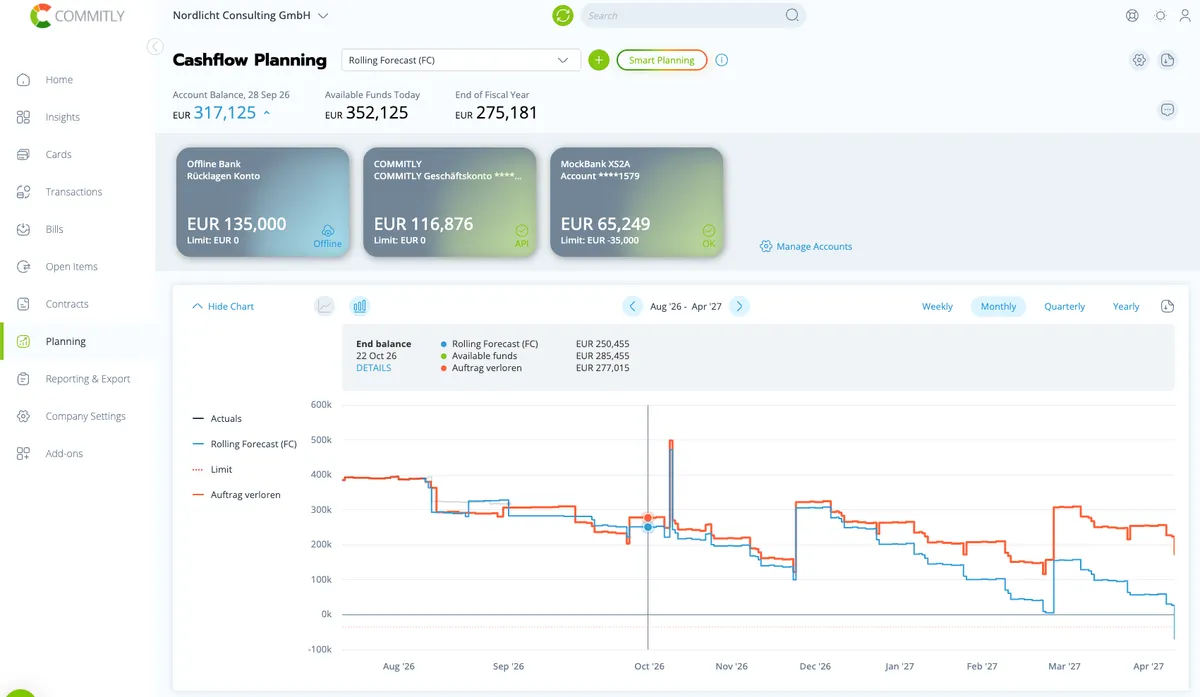
Modern cash flow and liquidity software helps to identify potential for internal financing. COMMITLY combines bank data, open items and invoice processing in real time and allows scenario planning for perfect decisions. You can see how much self-financing is possible, which reserves are available and how depreciation equivalents affect liquidity. At COMMITLY we focus on fast, professional support – without intrusive sales calls – and offer direct integrations that speed up internal financial processes considerably.


Frequently asked questions
This type of financing is worthwhile above all when sufficient profits or reserves are available and the company wants to remain independent. It is less expensive, because no interest or repayments are incurred, and at the same time it strengthens the equity ratio.