- Liquidität
Liquidity management software for mid-sized companies: what it does, what it costs, which providers count

Liquidity management software brings bank accounts, payment flows, open items and forecasts together in one tool — and thereby replaces what still happens in Excel at most mid-sized companies today. For SMEs with 5 to 250 employees and several banking relationships, the software has become standard rather than a luxury. Unlike treasury management systems for large corporations, the focus is on operational cash flow management: 13-week forecast, plan/actual comparison, direct bank connection. This guide explains what liquidity management software does, how you recognise a good solution, which providers currently count, what they cost — and when moving away from Excel really pays off.
What is liquidity management software?
Liquidity management software is a software tool that automates a company’s short- and medium-term cash flow management. It connects bank accounts directly, takes over open items from the bookkeeping, forecasts the development of liquidity over the coming weeks and months and reconciles planned with actual figures. The goal: a reliable answer at any time to the question “How much money do we have and when, and is that enough?”
The term overlaps with “cash flow software” and “cash flow planning software” and is often used synonymously. Liquidity management emphasises the active management element: not just planning, but reacting to deviations. That includes receivables management, scenarios — and with some solutions also the approval and payment of invoices.
Liquidity management software vs. treasury management system
Liquidity management software for mid-sized companies and treasury management systems for large corporations solve similar problems — but on completely different scales.
Liquidity management software (COMMITLY, Agicap, Tidely, finban): SMEs and mid-sized companies, a handful of banking relationships, focus on operational cash flow, setup in days. According to the providers, entry prices are around EUR 35 to 55 per month; for larger mid-sized companies there are individual quotes.
Treasury management systems (Kyriba, GTreasury, TIS, Nomentia): large companies and corporate groups with many entities, international cash pooling, hedging and risk management. Pricing on request, implementation in months.
The line is not a hard one. In between are growing companies that need more control — several entities, approvals, company cards — but for which group treasury would be far too big. That is exactly what COMMITLY is built for: more than planning, less than group treasury.
What good liquidity management software has to be able to do
Functions that every serious solution should master in 2026:
- Direct bank connection via PSD2, ideally via several regulated banking aggregators, plus EBICS for larger companies
- Automatic transaction categorisation with AI support — and approval by a human
- 13-week cash flow forecast as the standard view, optionally with longer horizons
- Day-accurate planning of incoming and outgoing payments
- Plan/actual comparison at weekly or monthly level with deviation analysis
- Open items from DATEV, Lexware Office, sevdesk or other accounting systems
- Scenario logic (“What happens if the big order only arrives in four weeks?”)
- An open, documented API for your own analyses, for example in Microsoft Power BI
Two points where you should take a close look:
- Several entities: Some tools only display accounts together, others genuinely consolidate — with a group dashboard and permissions per entity. More on this: consolidation for company groups.
- Fully automatic forecasts: A forecast without human control is risky and an issue under the EU AI Act. Good solutions suggest, you approve.
The most important liquidity management software providers in the DACH region (as at October 2026)
An overview of the providers most relevant to German mid-sized companies, sorted by suitability for SMEs and mid-sized companies, not by rating. All details come from the providers’ own websites. Fifteen providers side by side, every statement with source and date, are in our vendor list for cash flow planning software.
1. COMMITLY
COMMITLY is the cash flow platform for SMEs in the EU that reaches from the plan to the payment. More than 5,000 banks in the EU are connected via PSD2 through several regulated banking aggregators, plus FinTS and EBICS. Open items come from DATEV, Lexware Office, sevdesk, BuchhaltungsButler, weclapp, MOCO and Zoho Books. Planning works with a rolling forecast, scenarios and plan/actual comparison; the add-ons Bills and Card & Wallet add invoice approval, payment and company cards. Several entities can be consolidated, there has been an open API since 2022, plus an MCP server for your own AI. OMR Leader in cash flow planning for eight quarters, rated 4.8 from more than 140 reviews. Hosted in Germany, certified to ISO/IEC 27001:2022; COMMITLY follows the EU AI Act. Fair and transparent from EUR 55 per month, with attractive discounts on 12- and 24-month terms (prices), 14-day free trial without a credit card. Less suitable for corporate groups with cash pooling, hedging or consolidated financial statements.
2. Agicap
Agicap describes itself as treasury management for mid-sized companies, with dedicated offers for smaller businesses. Bank connection via EBICS, SWIFT, host-to-host and PSD2, by its own account more than 2,000 banks. Rolling 13-week planning with scenarios, payments with approval, company cards, a consolidated group view and cash pooling, a public API and an MCP server. No public list prices, individual quote. Certified to ISO 27001:2022.
3. Tidely
Cash flow planning from Munich, from the plan for freelancers to the one for large company groups. Bank connection via several banking aggregators, EBICS as an add-on module. Open items from Lexware Office and sevdesk from the Professional plan upwards, from DATEV as an add-on module. Scenarios, AI forecast, plan/actual comparison; according to Tidely, it does not initiate payments. Prices from EUR 55 per month, with a discount on one- and two-year contracts.
4. finban
Cash flow planning for small businesses, by its own account from the self-employed to groups with several entities. Bank connection via PSD2, Lexware Office and sevdesk connected directly, DATEV via file import. Forecast over 12 months, best- and worst-case scenarios, plan/actual comparison; according to finban, it cannot initiate payments. Prices from EUR 35 per month, 14-day trial without a credit card.
5. Embat
Treasury platform from Madrid with offices in Berlin and Munich, for mid-sized companies where spreadsheets reach their limits. Bank connection via APIs, PSD2, EBICS and SWIFT, ERP data from DATEV and SAP among others, payment runs with approval, a consolidated overview across entities and currencies, AI agents. Pricing on request.
6. re:cap
Since August 2026 geared towards the question of what capital a company can obtain; re:cap brokers financing. The target group is growing SMEs with annual revenue of EUR 250,000 or more. Bank connection via PSD2 (without EBICS), forecasts over 6 to 24 months with scenarios; according to re:cap, it cannot move money. Essential plan free of charge, Pro from EUR 79 per month.
7. Qonto
A business account with cash flow functions, not a pure planning tool. External accounts via PSD2, EBICS from the Business plan upwards; forecast and scenarios from the Smart and Essential plans respectively. Strong on payments, cards and approval of supplier invoices, as long as Qonto is the main account. Open items from the bookkeeping as a source for the forecast: not stated. Starter plan free of charge, forecast from EUR 19 per month.
8. Trezy
French provider, in the German-speaking market since March 2026, for sole proprietors up to companies with around fifty employees. Bank connection via PSD2, AI forecast over 12 months; a connection to DATEV, Lexware Office or sevdesk is not stated. Free plan, paid plans from EUR 9 per month.
9. Lucanet
Platform for consolidation, planning and cash management with more than 6,500 customers. EBICS bank connection, payments, cash forecasting from the Advanced package upwards. Sensible for mid-sized groups with a consolidation obligation and IFRS reporting, over-dimensioned for pure liquidity management. Pricing on request, minimum term 12 months.
And sevdesk, Lexware Office or DATEV?
Accounting software supplies the data — invoices, open items, categories — from which a cash flow plan is built. Some systems include a simple outlook, such as DATEV Liquiditätsmonitor online or “Planung & Prognose” (planning & forecast) in Lexware Office. What the accounting systems can do themselves and when a separate plan comes on top is shown in our comparison: cash flow planning with accounting software.
How do you move from Excel to liquidity management software?
Moving from Excel-based cash flow planning to professional software is not usually a major project. Three steps:
First: connect the bank accounts. With modern tools this is done via PSD2 in under an hour. Solutions with several regulated banking aggregators such as COMMITLY also cover savings banks (Sparkassen) and cooperative banks (Volks- und Raiffeisenbanken).
Second: connect the bookkeeping. Open items from DATEV come in via the DATEV uploader, Lexware Office, sevdesk and weclapp via their interfaces. That way, open items flow into the forecast.
Third: take over existing Excel categories as planned values. Most tools import CSV exports directly. Smart Mapping (or comparable AI categorisation) suggests the allocation of historical transactions, you approve — usually one to two hours of correction work. This controlling step is important so that the plan stays meaningful.
Total duration typically: one to three days. After that the plan/actual comparison runs automatically.
What does liquidity management software cost?
Pricing models differ considerably. Orientation based on the providers’ own details (as at October 2026, net):
Entry plans: from free or EUR 9 (Trezy) through EUR 35 (finban) to EUR 55 per month (COMMITLY, Tidely). COMMITLY is fair and transparent from EUR 55 per month, with attractive discounts on 12- and 24-month terms; the editions in detail are on our prices page.
Mid-sized companies with individual quotes: Agicap, Embat and Lucanet do not publish list prices.
Treasury management systems for corporate groups: pricing on request, plus implementation and consulting costs.
Price does not necessarily correlate with the benefit for an individual company. What matters is whether the range of functions and the actual requirement match — not “the more expensive, the better”. Also watch out for add-on modules: EBICS, a DATEV connection or additional entities cost extra with some providers.
When is liquidity management software worth it, and when is Excel enough?
Excel may be enough if all of the following apply:
- At most one banking relationship
- Fewer than 50 transactions per month
- No open items from receivables management
- No employees who have to work with the plan
- The planning horizon does not go beyond 4 weeks
Liquidity management software is worth it as soon as at least three of the following apply:
- Two or more banking relationships
- Several people maintain the plan together
- DATEV, Lexware Office or ERP data is relevant
- A forecast horizon of 13 weeks or longer
- Bank meetings or investor reporting require a clean liquidity overview
- Maintaining Excel costs more than an hour a week
Rule of thumb: as soon as more than one person-day a month goes into maintaining liquidity figures, the investment in software is almost always economical. How to calculate the upkeep of your own spreadsheet is shown in our article Build your own cash flow tool.
COMMITLY for liquidity management — when it fits and when it does not
COMMITLY fits if:
- your company is growing and needs more control than a spreadsheet offers
- several banking relationships or entities are involved
- DATEV, Lexware Office, sevdesk, weclapp or similar accounting is in use
- a 13-week forecast, scenarios and plan/actual comparison should be standard
- invoice approval and payment should run in the same system
- information security (ISO 27001) and the EU AI Act play a role
COMMITLY is not the right choice if:
- consolidated financial statements under HGB or IFRS with capital consolidation are required
- treasury functions such as cash pooling, hedging or interest rate management are mandatory
- the most important accounts are outside the EU
- P&L and balance sheet planning with in-depth FP&A logic is needed
In those cases, consolidation and planning platforms such as Lucanet or Jedox, or treasury systems such as Nomentia or Kyriba, are the more appropriate tools.
In 2026, liquidity management software is no longer a tooling luxury but an operational standard for every mid-sized company from five employees upwards. The greatest leverage lies not in switching provider but in switching away from Excel — and with modern tools that is done in one to three days. What COMMITLY means in concrete terms for growing companies is on our page about cash flow software.
Credits: Photo by Unsplash


Bank, accounting and planning in one platform. Fair & transparent.
Try it for free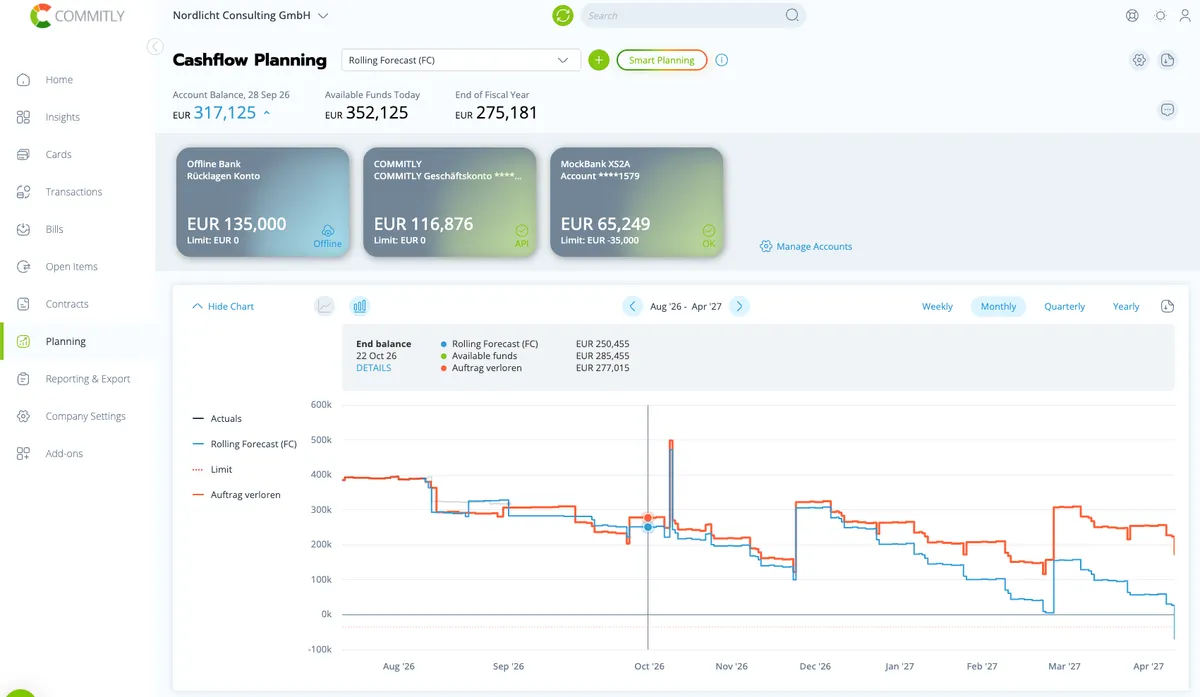
Frequently asked questions
Liquidity management software is a tool for automated cash flow management. It connects bank accounts directly, takes over open items from the bookkeeping, forecasts liquidity over the coming weeks and reconciles planned with actual figures. Standard for mid-sized companies replacing Excel-based planning.