
DATEV uploader
Upload the OPOS list — receivables and payables land in the cash flow plan.
Your bookkeeping lives in DATEV, your cash flow plan in COMMITLY — the DATEV uploader connects the two. You upload the OPOS list, and your open receivables and payables appear in the plan with their due dates. What cash flow planning with DATEV looks like as a whole — and what DATEV brings itself — is on the page Cash flow planning with DATEV.
How your open items reach COMMITLY
Export the OPOS list in DATEV and upload it in COMMITLY. The optimised uploader recognises the format, separates receivables from payables and takes over invoice number, amount and due date. Uploading again updates the set instead of duplicating it.
There is no access to your DATEV account. You stay in control of which file goes to COMMITLY and when — for many practices and finance teams that is exactly the condition under which cash flow planning becomes an option at all.
What gets transferred
From every document COMMITLY takes the fields that matter for planning:
- Amount and currency, gross — the way the money actually arrives or leaves.
- Due date, the day payment would be required.
- Expected payment date, the day payment usually happens. You can override it per item.
- Counterparty, customer or supplier, so receivables can be grouped by payment behaviour.
- Document and invoice number, so every incoming payment can be matched without ambiguity.
- Status: open, partially paid, paid, overdue, disputed.
Journal entries, ledger accounts and tax keys are not transferred. They stay in DATEV, where they belong. COMMITLY plans the cash flow; it does not do the bookkeeping.
What happens next
Every open item gets an expected payment date — not necessarily the due date, but the day payment usually arrives. A customer who has been paying ten days late for years sits in the plan realistically instead of too early.
Payments from your bank accounts are matched against the open items automatically. Matching works on amount, reference and counterparty, and it recognises partial payments and bulk transfers that settle several invoices at once. Where the match is not unambiguous, COMMITLY proposes it and you approve — the AI suggests, you decide.
Whatever is matched leaves the open items and sits in the plan as an actual figure. Whatever stays open moves forward with its expected date. Overdue items are marked, so you can see where to follow up.
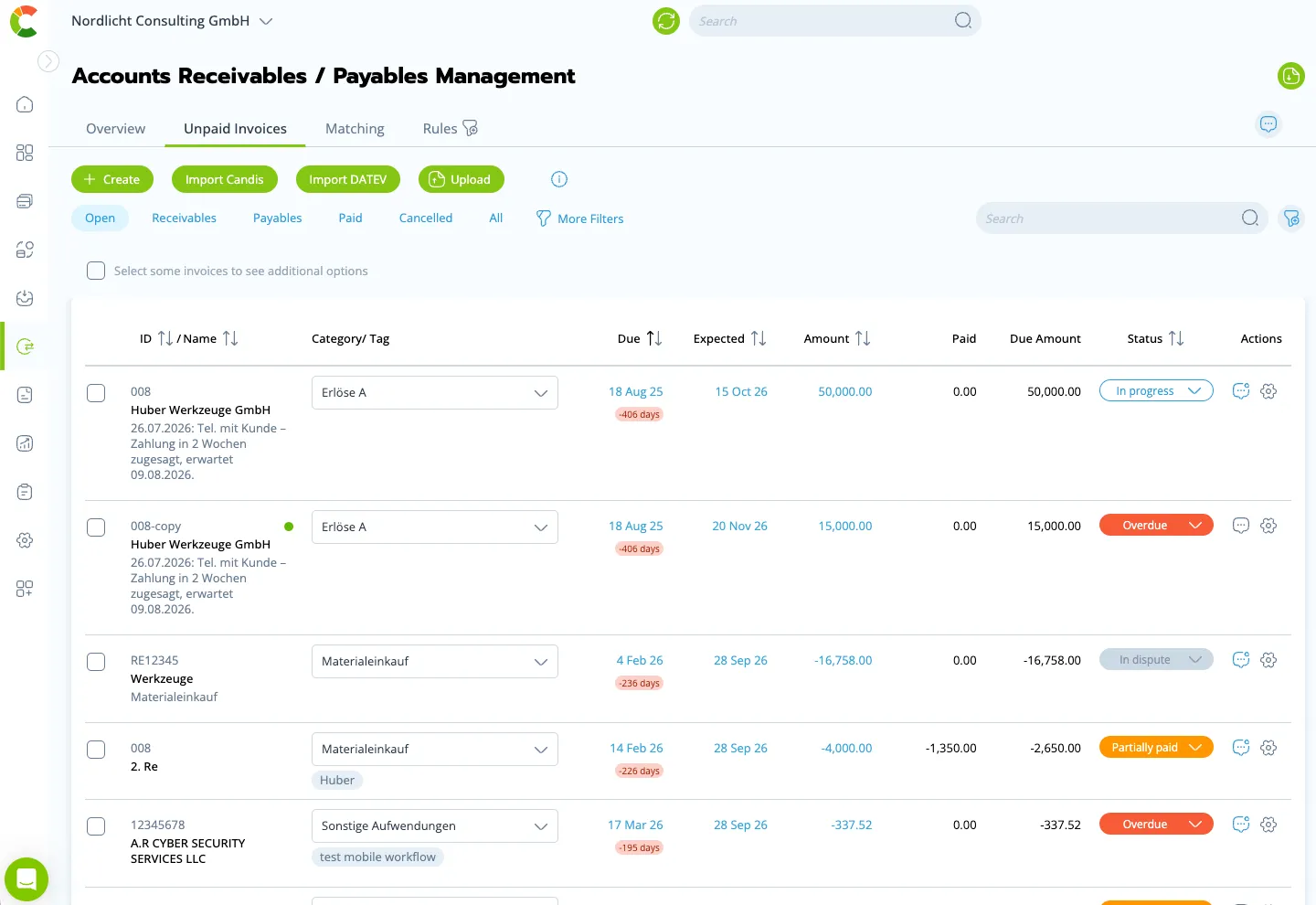
Why this changes the plan
A cash flow plan without open items is an estimate. With them it becomes a calculation: you see which money arrives when and which liability leaves when — and therefore whether things get tight in eight weeks or not.
The difference shows up where it counts. An order that slips by four weeks moves its payment with it, and the receivable moves in the plan. A supplier who insists on payment up front changes the curve immediately. And because actual figures keep arriving from your bank accounts, the plan corrects itself instead of being redone by hand once a month.
That is the basis for everything that follows: scenarios built on solid ground, a rolling forecast that does not have to be rebuilt every week, and reports that hold up in front of a bank.
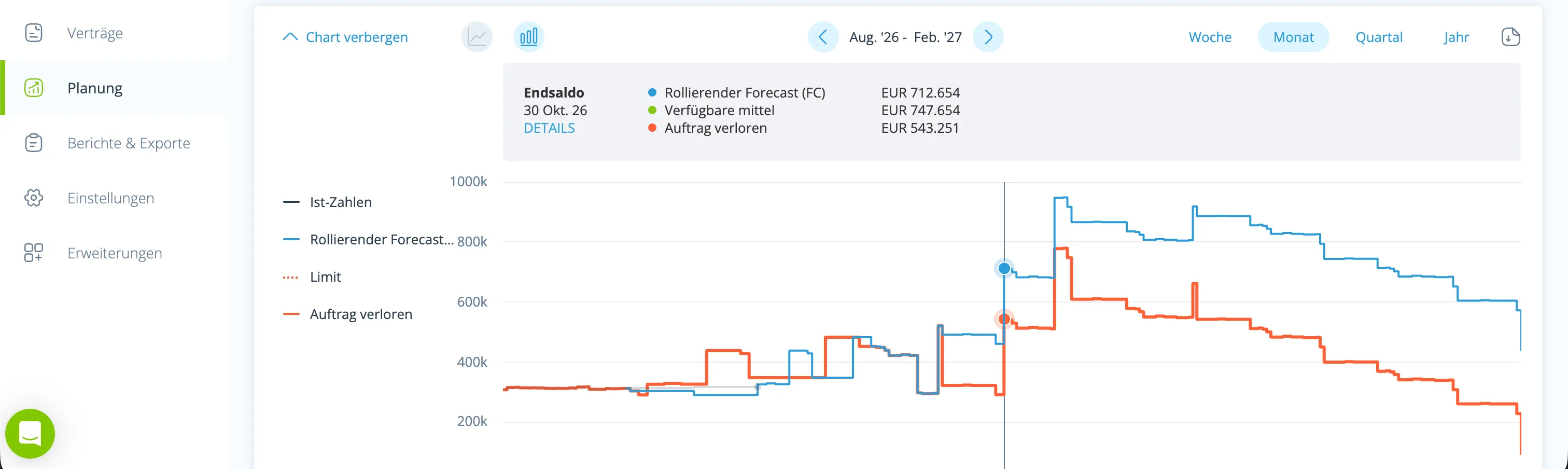
What you need for this
Access to the OPOS report in DATEV so you can export the file, and a COMMITLY account. You activate the uploader once under Extensions — no installation, no project, no consultant.
Realistically: the first upload takes minutes. Allow one to two hours for a first cash flow plan you can rely on, because you will go through the categories and the expected payment dates once. After that, around 15 minutes a week is enough.
COMMITLY is hosted in Germany and certified to ISO/IEC 27001:2022; a data processing agreement is available on request.
Who benefits most from this
Companies whose bookkeeping runs on DATEV, at their tax advisor’s or in their own finance department — the normal case in the German mid-market. The typical situation: the numbers are booked properly, but they only arrive with last month’s report. The uploader closes exactly that gap. Your open items sit in the plan as soon as you upload the list, not when the monthly report arrives.
Understanding open items in DATEV
What open items are and how to read the OPOS list in DATEV is explained in this video by Andreas Hausmann — independent of COMMITLY, but the clearest explanation we know. It is in German.
What you do in COMMITLY
Three steps, described in full in the help centre:
- Activate the DATEV uploader under Extensions.
- Go to Open items → Open items list and click Load DATEV.
- Pick the file exported from DATEV — done. Every further upload refreshes the set.
Frequently asked questions
You need access to the OPOS report in DATEV to export the file. COMMITLY does not connect to your DATEV account itself — the transfer runs through the file upload.
You might also like

Open items flow from BuchhaltungsButler into the plan automatically.

Open items flow from Lexware Office into the plan automatically.

Open items flow from sevdesk into the plan automatically.
